

AI video editing tools are changing how creators produce videos in 2026. They can turn raw clips, scripts, images, and audio into polished content with less manual work. From automatic captions to smart scene selection, these platforms help creators handle repetitive tasks while keeping control over the final creative result.
For YouTubers, influencers, marketers, educators, and businesses, AI video editing tools can simplify production.
AI Video Editing
AI video editing tools use artificial intelligence for trimming, scene selection, transitions, enhancement, audio synchronization, and other editing tasks.
An AI video editor can make professional-looking projects accessible to beginners.
AI Video Creation
AI video editing tools increasingly include AI video generation, text-to-video, prompt-to-video, and script-to-video features.
These systems can turn written ideas into scenes, narration, visuals, and an initial video structure.
Video Editing Features
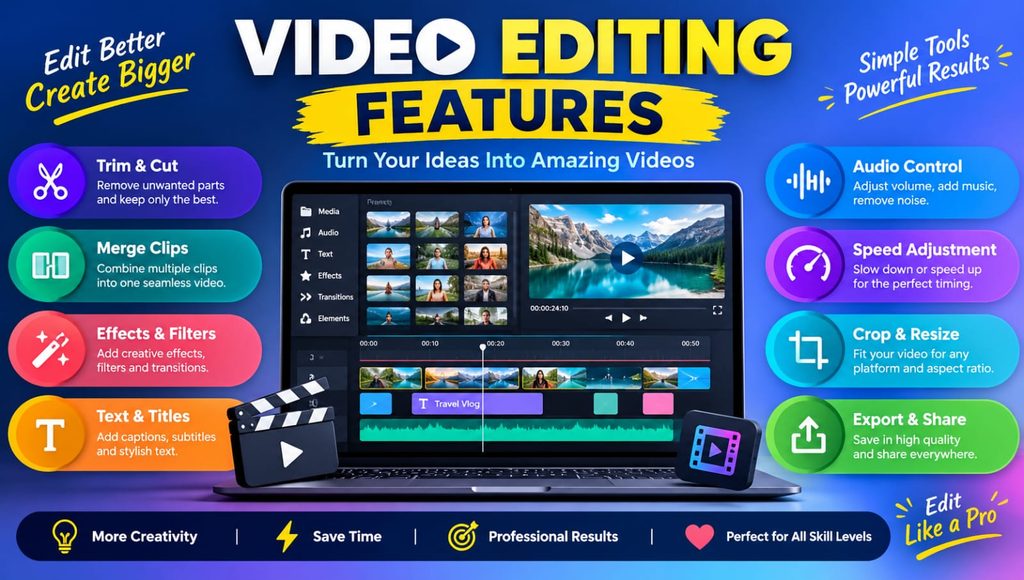
AI video editing tools commonly include video trimming, cutting, resizing, cropping, clip editing, scene editing, timeline editing, transitions, effects, filters, animations, and motion effects.
These features cover many everyday production needs.
AI-Powered Editing
AI-powered editing can detect scenes, select useful clips, improve visuals, and suggest adjustments.
AI video editing tools may also provide AI transitions, automatic enhancement, and content-aware editing. These features create a starting point rather than replacing creative decisions.
See more:AI video editing tools
Text-to-Video & Script-Based Editing
Text-to-video generators let creators describe a video through prompts.
Script-to-video systems can divide written content into scenes and combine visuals, narration, and captions.
AI video editing tools can connect script editing with scene generation and storyboard creation.
AI Video Enhancement
AI video editing tools improve existing footage through resolution enhancement, image upscaling, brightness adjustment, contrast correction, color enhancement, and video optimization. These functions can help prepare older or lower-quality recordings.
However, enhancement cannot always restore details that were never captured, so original recording quality remains important.
Audio & Voice Features
Audio features can include AI voiceover, text-to-speech, voice narration, background music, sound effects, audio enhancement, and speech generation.
AI video editing tools may also support voice cloning, voice customization, and audio synchronization. Creators should check licensing and consent requirements when using synthetic or cloned voices.
Captions & Subtitles
AI subtitles and auto captions use speech-to-text technology to convert dialogue into written text.
AI video editing tools may offer caption customization, multilingual subtitles, translated captions, and synchronized text. These features can improve accessibility and help creators reach different audiences.
Templates & Creative Assets
AI video templates provide ready-made structures for different content types.
AI video editing tools with media libraries can reduce the need to gather assets from several websites. For commercial projects, users should still check the licensing terms of stock footage, music, images, and other creative materials.
Social Media Video Creation
Social media videos need fast production and flexible formats.
AI video editing tools can support YouTube videos, YouTube Shorts, Instagram Reels, TikTok videos, Facebook videos, vertical content, promotional clips, and other short-form projects.
Automatic resizing and aspect-ratio controls make repurposing easier. One recording can be adapted into vertical, square, or landscape versions, helping creators publish the same core message across social channels.
Branding & Customization
Brand consistency is important for creators and businesses that publish regularly. A brand kit can store colors, fonts, logos, and design elements, helping new projects follow a recognizable visual identity.
AI video editing tools can support custom templates, branded videos, personalized content, and marketing assets. These features help teams maintain consistent designs while changing footage, messages, layouts, and calls to action for individual campaigns.
AI Video Tools for Creators
AI video editing tools are useful for content creators, YouTubers, influencers, video marketers, educators, freelancers, filmmakers, and creative professionals.
The right tool depends on the content type. A YouTuber may need long-form editing, while a social creator may prioritize captions, vertical templates, and quick exports. Businesses may focus more on branding, collaboration, and marketing features.
Video Marketing
Video marketing uses visual content to explain products, promote services, communicate campaigns, and engage audiences.
AI video editing tools can support product videos, advertisements, explainers, promotional videos, and demonstrations.
Marketing teams can create several versions of a campaign for different platforms. Narration, captions, branded graphics, and calls to action can be combined in one workflow, while human review helps maintain accurate and consistent messaging.
Collaboration & Workflow
Online video editors provide cloud-based workspaces where teams can store projects, review drafts, organize media, and coordinate changes. Collaborative editing can reduce the need to repeatedly transfer large project files.
AI video editing tools can support a wider video production workflow by reducing repetitive work. Shared projects, real-time collaboration, project management, and content workflow features are useful when scripting, editing, approval, and publishing involve multiple people.
Export & Video Formats
AI video editing tools determine how easily content can be published. Creators may need MP4 export, HD export, 4K video, different resolutions, and aspect ratios for landscape, portrait, square, vertical, and horizontal formats.
AI video editing tools can simplify preparing one project for several channels. Before exporting, creators should check resolution, frame rate, file size, aspect ratio, audio quality, and the requirements of the target platform.
| Tool | Key Strength | Useful For | AI Features |
|---|---|---|---|
| Adobe Firefly | Generative video | Creative work | Text-to-video, image-to-video |
| Canva | Visual workflow | Social content | Magic Media, templates |
| InVideo AI | Prompt-based production | Marketing | Script-to-video, AI voice |
| CapCut | Fast social editing | Short-form | Captions, smart editing |
| Descript | Text-based editing | Podcasts | Transcription, AI voice |
| VEED | Online editing | Marketing teams | Captions, AI tools |
| Runway | Generative video | Creative projects | Video generation, effects |
| Filmora | Desktop editing | Beginners | Enhancement, smart editing |
| Pictory | Script-based video | Education | Script-to-video, captions |
| OpusClip | Repurposing | Social creators | Clip selection, captions |
Multilingual & Accessibility Features
Multilingual video creation can help creators reach international audiences. AI translation, translated subtitles, multilingual voiceover, automatic captions, and multiple-language support can make one video easier to adapt for different markets.
AI video editing tools with accessibility features can improve usability for wider audiences. Captions, readable text, clear narration, and translated versions can support viewers with different needs. Automated translations should still be reviewed for names and technical terms.
Adobe Firefly & Generative Video Terms
Adobe Firefly supports generative AI workflows for creative production. Its video-related features can include text-to-video generation, image-to-video, reference images, prompts, and generative effects, giving creators ways to develop visual concepts.
AI video editing tools in the generative category can help create AI-generated video clips and cinematic experiments. Reference images and detailed prompts can guide visual direction, while creators can review generated results before using them in finished projects.
Canva AI Video Terms
Canva AI video editor features focus on an accessible visual workflow. Magic Media, Canva templates, animated graphics, drag-and-drop editing, and AI-powered design can help users create videos without a complicated professional timeline.
AI video editing tools within design platforms can suit creators who already use presentations, graphics, brand templates, and marketing assets. Keeping these functions together can simplify visual content creation and maintain brand consistency.
InVideo AI Video Terms
InVideo AI combines video generation with editing features such as text-to-video, script-to-video, AI avatars, AI voiceovers, stock media, and video templates. Users can start with written instructions and then refine the generated project.
AI video editing tools such as InVideo AI can support social media videos, marketing content, and other projects that require quick production. Creators can review the script, media, narration, and scenes before exporting.

How AI Video Editing Saves Time
AI video editing tools automate repetitive tasks such as trimming clips, adding captions, removing unwanted sections, improving audio, and creating quick transitions. This allows content creators to spend less time on manual editing and more time developing creative ideas.
For YouTubers, marketers, and social media creators, AI-powered editing can also make it easier to produce videos in different formats and styles. With features like automatic subtitles, smart scene detection, and AI-generated effects, creators can speed up their workflow while maintaining professional-looking content.
See more:AI video editing tools
AI Video Editing Benefits
The benefits of AI video editing tools include faster video production, time-saving editing, automated workflow, beginner-friendly controls, and reduced repetitive work. They can help creators move from raw footage or an idea to a workable draft more efficiently.
Another benefit is scalable video creation. When many videos are needed, automation can support captions, resizing, narration, templates, and repeatable workflows. Human review remains important for accuracy, originality, brand consistency, and creative direction.
FAQs
1. What are AI video editing tools?
AI video editing tools are software platforms that use artificial intelligence to assist with editing, captions, audio, enhancement, scene selection, generation, and other video production tasks.
2. Can AI video editing tools create videos from text?
Yes. Many platforms offer text-to-video or script-to-video features that can turn written prompts or scripts into scenes, narration, captions, and draft videos.
3. Are AI video editing tools suitable for beginners?
Yes. Many tools include templates, drag-and-drop controls, automatic captions, smart editing, and guided workflows that make video creation easier for people with limited editing experience.
4. Can creators use AI video editing tools for YouTube and social media?
Yes. Creators can produce YouTube videos, Shorts, Reels, TikTok content, promotional videos, and other formats, depending on the platform’s editing and export features.
5. What should creators consider before choosing an AI video editor?
Compare editing features, AI generation, captions, voice tools, templates, branding, collaboration, export quality, pricing, licensing terms, and compatibility with your content workflow.

