

AI Search Tools are changing the way people find information online in 2026. Instead of opening many websites and checking different pages, users can ask questions in natural language and receive organized answers with relevant sources.
Modern search platforms can understand context, summarize information, compare sources, and help users discover useful content faster. They are becoming valuable for students, researchers, developers, businesses, marketers, and everyday internet users.
AI Search & Search Engines
AI Search Tools combine traditional web search with artificial intelligence to understand what a person actually wants to find. They can process natural language queries and provide more direct answers than traditional keyword-based search.
AI search engines use intelligent search technology to analyze websites, documents, and online information. Many platforms provide AI-powered search results that summarize important details while still allowing users to visit the original sources.
These platforms are useful when a search requires more than a simple webpage. Users can perform online research, explore unfamiliar topics, discover new information, and interact with search results through conversational interfaces.
Conversational & Natural Language Search
Conversational search allows users to communicate with a search engine almost like they are talking to an assistant. Instead of entering short keywords, users can ask complete questions and continue with follow-up queries.
Natural language search helps systems understand user intent, context, and the meaning behind a query. This makes searching easier for people who do not know the exact keywords required to find specific information.
Context-aware search can remember the subject of previous questions within a conversation. This allows users to ask additional questions without repeatedly explaining the same topic.
Chatbot search and conversational AI are also useful for question answering. Users can receive direct answers, request clarification, compare information, or ask the system to explain difficult subjects in simpler language.
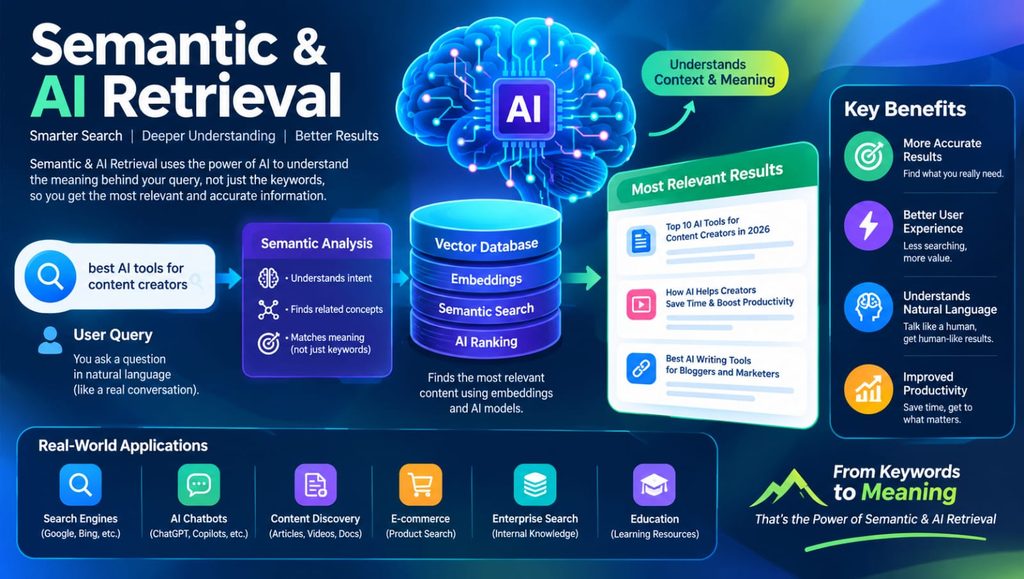
Semantic & AI Retrieval
Semantic search focuses on the meaning of a query rather than matching only individual words. This allows search systems to identify content that is conceptually related to what the user is looking for.
AI retrieval systems can use embeddings, vector search, and similarity matching to connect questions with relevant information. This technology is especially important for modern knowledge retrieval and enterprise search applications.
Meaning-based search can improve content discovery because related concepts may be found even when the exact words used in the query are different. This is useful for research, documentation, customer support, and internal knowledge systems.
Retrieval-augmented generation, commonly known as RAG, combines information retrieval with language models. It allows AI systems to retrieve relevant information before generating an answer, helping create more grounded responses.
Web Search & Current Information
One major advantage of modern AI Search Tools is their ability to work with current web information. Traditional AI models may have knowledge limitations, while web-connected systems can search recently published pages.
Real-time web search can help users discover fresh information, current events, technical documentation, market developments, and recently updated websites. Search freshness is particularly important when information changes frequently.
Fresh search results are also useful for news discovery and online research. Users can check multiple web pages instead of depending on an old article or outdated database.
Web indexing plays an important role in this process. Search platforms continuously discover and organize online content so that relevant pages can appear when users submit queries.
AI Search for Research
Researchers can use AI Search Tools to reduce the time required to collect and organize information. AI research platforms can search across articles, academic papers, reports, and other sources.
Academic research often involves reviewing large amounts of material. AI-powered systems can help users locate relevant papers, understand research findings, and create summaries of complex topics.
Literature search becomes easier when users can describe their research question naturally. Some systems can identify related studies and help users explore a subject from multiple perspectives.
Source verification remains important during research. Users should check original papers, citations, and authoritative sources before treating an AI-generated answer as established evidence.
Deep research workflows can also support information analysis. Instead of performing every search manually, users can use AI to organize findings and identify connections between different sources.
See more:AI Search Tools
AI Search for AI Agents
AI agent search tools are designed for applications where AI agents need access to external information. An autonomous agent may need to search websites, retrieve information, and use the results while completing a larger workflow.
Agentic search combines search technology with AI agents and language models. These systems can support tasks such as research automation, technical discovery, data collection, and information retrieval.
LLM-powered search is particularly useful for AI applications because search results can be delivered in formats that language models can process more easily.
Machine-readable and structured search results can help developers build agent workflows. Instead of presenting information only as a visual webpage, search infrastructure can return useful content and metadata to software systems.
Search APIs & Developer Tools
Developers can integrate AI Search Tools into applications through search APIs. A search API can allow software to send queries, retrieve results, and process information automatically.
Search APIs may provide structured responses containing titles, URLs, descriptions, metadata, and other useful fields. JSON results are commonly used because they are easy for applications to process.
Developer tools can also offer domain filtering, language filtering, freshness controls, and search parameters. These options allow developers to customize search behavior according to application requirements.
Scalability and rate limits are important considerations when selecting a search API. Applications with large numbers of users may require reliable infrastructure, low latency, and sufficient request capacity.
Search integration can support chatbots, research assistants, coding tools, RAG applications, customer support systems, and many other AI-powered products.
Search Results, Citations & Accuracy
Search quality depends heavily on the relevance and reliability of the information returned. AI Search Tools can improve the experience by organizing results and showing useful source citations.
Citations allow users to trace an answer back to the original source. This is particularly valuable when researching technical, academic, business, or factual information.
Source attribution also helps users evaluate where information came from. Authoritative sources, official documentation, research papers, and established publications can provide stronger evidence than unknown websites.
AI-generated answers should still be verified when accuracy matters. Search systems can sometimes misunderstand queries, select weak sources, or generate incorrect interpretations.
Grounded answers and evidence-backed responses are important because they can reduce the risk of unsupported claims. Human verification remains valuable for high-impact decisions and professional research.
Web Crawling & Content Extraction
Web crawling allows search systems to discover pages across the internet. Crawlers examine websites and collect information that can later become searchable.
Content extraction focuses on identifying useful information from webpages. Modern systems may remove unnecessary page elements and provide clean webpage content that is easier for AI models to process.
LLM-ready content is especially useful for AI applications. Developers can retrieve relevant webpage information without manually processing every part of an HTML page.
Dynamic websites can create additional technical challenges because important content may be loaded through JavaScript. Advanced web data platforms can handle different website structures and extraction requirements.
Web scraping and structured extraction can support research, monitoring, competitive intelligence, and automated data collection when used responsibly and according to applicable website rules.
Search Filtering & Customization
Search filters allow users to control the information they receive. Domain filtering can restrict results to trusted websites, while date filtering can prioritize recently published content.
Language and region filters are useful when research requires information from a particular country or language. Freshness controls can also help users focus on newer information.
Search customization allows users to create a more relevant experience. Instead of reviewing thousands of results, users can narrow searches according to their specific requirements.
Trusted domains and curated sources can be especially useful for professional research. They help users focus on websites that are relevant to their subject.
Content filters and metadata filters can further improve result discovery. These features are valuable when searching large information collections.
AI Search Privacy & Security
Privacy is an important consideration when choosing an AI Search Tools platform. Some users prefer services that minimize tracking, protect search history, and provide stronger privacy controls.
Privacy-focused search engines can reduce unnecessary data collection and offer alternatives to heavily personalized search experiences. Users should review each platform’s privacy policy before using it for sensitive research.
Search history may contain valuable personal information about interests, projects, or work. Privacy-friendly services can provide additional controls over how this information is handled.
Secure search practices also include avoiding unnecessary personal information in queries. Users should be careful when searching for confidential business information or private documents.
AI Search for Business & Productivity
Businesses can use AI Search Tools for market research, competitive intelligence, customer research, and product discovery. Faster information retrieval can help teams spend more time analyzing information instead of collecting it manually.
Enterprise search can connect employees with internal documentation, company knowledge, reports, and other resources. This can improve knowledge management across larger organizations.
Business intelligence workflows can also use AI search to discover market trends and relevant information. Research assistants may summarize large amounts of material and organize findings for further review.
Productivity improves when repetitive research tasks are partially automated. AI assistants can help users locate documents, investigate questions, and prepare information for business workflows.
Popular AI Search Tool Features
Modern search platforms offer a wide range of features. AI-generated summaries can provide quick explanations, while source links allow users to investigate the original information.
Many platforms support follow-up queries, allowing users to continue exploring the same subject. Some also provide image search, video search, news search, and shopping search.
Multimodal search expands search beyond text. Users may be able to combine images, written questions, and other information when exploring a topic.
AI browsers and browser agents can go beyond traditional search. They may help users navigate websites, retrieve information, and complete certain web-based tasks.
These features make search more interactive and useful for different types of online research.

AI Search Technology & Performance
Search performance depends on several technical factors, including search speed, relevance ranking, index coverage, and index freshness. A fast system is useful, but results must also be relevant.
Low latency is important for applications that need quick responses. Developers building AI assistants or production systems often require reliable search infrastructure.
Machine learning and natural language understanding help search systems process complex queries. Large language models can improve how systems interpret questions and organize retrieved information.
Semantic indexing allows platforms to connect concepts rather than relying only on exact keyword matches. Content ranking then determines which information should appear more prominently.
Production AI systems require reliability, scalability, and consistent performance. These factors become increasingly important as search technology is integrated into everyday applications.
See more:AI Search Tools
AI Search Use Cases
AI Search Tools can support online research, academic research, SEO research, competitor analysis, market intelligence, and technical research. Their flexibility makes them useful across many industries.
Content researchers can use AI search to discover topics, compare sources, and identify useful information for articles. SEO professionals can investigate competitors, search trends, and content opportunities.
Developers can use search for documentation lookup, coding research, RAG applications, and AI assistants. Businesses can apply search technology to customer support, product research, and internal knowledge systems.
Fact checking is another important use case. Users can search multiple sources, examine citations, and compare claims before reaching their own conclusions.
Research agents and automated workflows can also use real-time information retrieval. As AI continues to develop, search will increasingly become an important part of intelligent applications.
FAQs
1. What are AI Search Tools?
AI Search Tools use artificial intelligence to understand queries, retrieve relevant information, summarize results, and sometimes provide citations from online sources.
2. How are AI search engines different from traditional search engines?
AI search engines can understand natural language, maintain conversational context, summarize information, and provide direct answers instead of showing only a list of links.
3. Are AI search results always accurate?
No. AI-generated answers can contain errors or misunderstand sources. Important information should be checked against the original and authoritative sources.
4. Can developers use AI search APIs?
Yes. Many search platforms provide APIs that developers can integrate into applications, AI assistants, RAG systems, research tools, and automated workflows.
5. What can AI search be used for in 2026?
AI search can support research, education, SEO, business intelligence, technical documentation, competitor analysis, content discovery, customer support, and real-time information retrieval.

