

AI Agent Tools are changing how individuals and businesses handle repetitive tasks, workflows, research, communication, and daily operations. Instead of simply generating an answer, modern AI agents can understand a goal, plan tasks, use connected tools, and complete multiple steps with less manual input.
AI Agent Tools can also improve productivity by connecting language models with automation platforms, business applications, APIs, databases, and other software. In 2026, these tools are being used for everything from customer support and marketing to software development, data analysis, and business process automation.
AI Agent Fundamentals
AI Agent Tools are software solutions designed to help users create or operate intelligent agents. AI agents can receive natural language instructions, understand context, plan actions, and execute tasks using connected applications or external tools.
Agentic AI goes beyond basic chatbot functionality by supporting autonomous AI agents, intelligent automation, autonomous workflows, and AI-powered agents. These systems can work as digital agents, virtual agents, or intelligent assistants for different productivity and business requirements.
AI Agent Building & Development
Modern AI Agent Tools make it easier to build AI agents without developing every component from scratch. AI agent builder platforms provide visual workflow builders, reusable components, natural language instructions, and automation features for creating custom AI agents.
No-code AI agents and low-code AI agents are especially useful for beginners and business teams. Users can create AI agents, connect applications, define instructions, and design workflows through an AI workflow builder or drag-and-drop workflow builder without extensive programming knowledge.
AI Agent Frameworks
AI agent frameworks provide the technical foundation required to develop and manage intelligent agents. Developers can use agent frameworks, multi-agent frameworks, and autonomous agent frameworks to create systems that perform complex tasks through structured workflows.
Agent orchestration is another important part of modern AI development. AI Agent Tools can coordinate different agents, models, tools, and actions through agent workflows. This makes multi-agent systems useful when several specialized agents need to collaborate on a larger objective.

AI Models & Reasoning
Large language models are an important component of modern agent systems. AI models provide natural language processing, generative AI capabilities, contextual reasoning, and machine reasoning that allow agents to understand instructions and generate useful responses.
AI Agent Tools can combine language models with task planning and goal-oriented AI capabilities. Model integration also allows developers to select different models depending on the task, while LLM agents can use contextual information to make decisions and perform actions.
AI Agent Automation
AI workflow automation allows agents to complete tasks that traditionally required manual work. Businesses can use AI Agent Tools for repetitive task automation, automated workflows, process automation, workflow orchestration, and multi-step automation.
For example, an agent can receive information, analyze it, update a connected application, send an email, and create a report. This type of AI-powered automation can turn several individual actions into one smart workflow with automated decision-making and workflow execution.
Tools, Integrations & APIs
Integrations allow agents to interact with external software and information sources. AI Agent Tools can connect with cloud applications, databases, APIs, webhooks, CRM systems, communication platforms, and other business software.
Tool calling and API access make agents more useful because they can perform actions instead of only generating text. MCP servers and the Model Context Protocol can also help connect AI systems with external tools, data sources, and software integrations in a structured way.
Multi-Agent Systems
Multi-agent systems use multiple AI agents that can work together on a shared objective. Instead of relying on one general-purpose agent, businesses can create specialized agents for research, analysis, writing, customer service, or decision support.
AI Agent Tools can support agent collaboration, agent coordination, and agent orchestration. An AI agent team may divide a large task into smaller responsibilities, allowing specialized agents to communicate and complete different parts of a workflow.
No-Code & Low-Code AI Agents
No-code AI agent tools allow users to create automation without writing traditional software code. Visual AI builders usually provide workflow templates, drag-and-drop automation, and ready-made AI workflows that can be customized for different requirements.
Low-code automation is useful for users who need more control while still avoiding complex development. These beginner-friendly AI tools can support natural language automation, AI tools without coding, and visual agent builders for business and productivity workflows.
AI Agent Use Cases
AI Agent Tools can be used across many departments and industries. Common examples include business automation, marketing automation, sales automation, customer support automation, data analysis, research automation, content creation, and lead generation.
Other use cases include CRM automation, meeting preparation, meeting summaries, competitor research, email automation, social media automation, SEO automation, coding assistance, and productivity tasks. The best use case depends on the workflow, available integrations, and level of automation required.
Business & Enterprise AI Agents
Enterprise AI agents can help organizations automate repetitive business processes while keeping workflows connected to existing systems. AI for businesses can support team productivity, enterprise workflows, organizational workflows, and AI-powered business processes.
AI Agent Tools can also contribute to scalable AI automation and enterprise integrations. Larger organizations may use a digital workforce to handle information retrieval, document processing, internal support, reporting, and other structured tasks while maintaining security controls.
AI Agent Productivity
AI productivity tools can act as personal AI assistants for research, task management, information retrieval, scheduling automation, and document processing. Instead of manually moving between different applications, users can automate several steps through connected productivity workflows.
AI Agent Tools can reduce the time spent on repetitive activities such as organizing information, preparing documents, managing emails, and collecting research. Workflow optimization allows users to focus more attention on creative, strategic, and decision-based work.
Agent Memory, Context & Data
Agent memory helps an AI system maintain useful information across tasks or interactions. Contextual AI can use previous instructions, documents, knowledge bases, and other information to provide more relevant results.
Retrieval augmented generation, commonly called RAG, allows agents to retrieve information from documents and other data sources. AI Agent Tools can use document retrieval, knowledge retrieval, structured data, unstructured data, and enterprise data to improve contextual understanding.
AI Agent Security & Control
Security is important when an AI agent can access applications, files, databases, or business information. AI agent security can include authentication, authorization, access control, permissions, data privacy, and secure integrations.
Organizations should also consider AI governance and workflow security when deploying autonomous systems. AI Agent Tools may provide role-based access control, audit logs, monitoring, and other controls that help businesses manage how agents access and use information.
AI Agent Monitoring & Evaluation
AI agents need monitoring because automated workflows can encounter incorrect information, failed actions, or unexpected results. AI observability helps teams track agent performance, workflow execution, errors, and task outcomes.
AI Agent Tools may include execution logs, workflow analytics, agent evaluation, AI testing, agent debugging, and performance tracking. These features can help identify workflow problems and improve agent reliability, task success rate, and overall AI quality control.
Popular AI Agent Platforms & Tools
Several platforms are becoming popular for building, automating, or managing AI agents. Gumloop focuses on AI-powered workflows, while n8n provides workflow automation capabilities. Relay.app combines automation with AI workflows, and Zapier connects AI capabilities with a wide range of applications.
For developers, Cursor provides AI-assisted coding capabilities, while CrewAI focuses on multi-agent systems. StackAI and Dust also provide platforms for building AI-powered workflows and agents. When comparing AI Agent Tools, users should consider integrations, automation capabilities, ease of use, pricing, security, and customization.
| Tool | Main Strength | Suitable For | Key Capability |
|---|---|---|---|
| Gumloop | AI workflows | Businesses | Workflow automation |
| n8n | Automation | Technical users | Visual workflows |
| Relay.app | AI automation | Teams | Automated processes |
| Zapier | Integrations | Businesses | App automation |
| Cursor | Coding | Developers | AI coding workflows |
| CrewAI | Multi-agent systems | Developers | Agent collaboration |
| StackAI | AI workflows | Enterprises | Custom AI applications |
| Dust | AI agents | Teams | Knowledge-based agents |
The right platform depends on the user’s requirements rather than a single feature. Some tools focus on no-code automation, while others provide developer-focused frameworks, APIs, multi-agent capabilities, or enterprise integrations.
AI Agent Features
Modern AI Agent Tools can provide autonomous task execution, goal-based execution, task decomposition, dynamic planning, and decision-making. These capabilities allow an agent to understand a larger objective and divide it into smaller actions.
Other features can include tool selection, context awareness, adaptive workflows, automated actions, real-time execution, and human-in-the-loop controls. Customizable agents and reusable workflows can also make automation easier to maintain and scale.
Developer-Focused AI Agent Tools
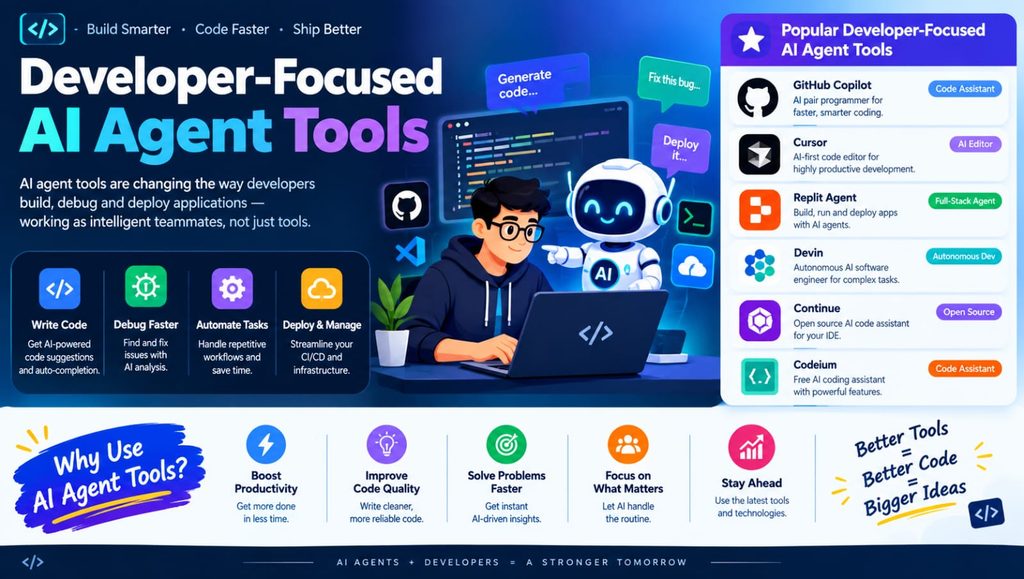
Developers can use AI coding agents and developer AI tools to automate parts of software engineering. AI IDEs, code agents, agent APIs, SDKs, and programming frameworks can help developers create custom agent workflows.
Python AI agents and JavaScript AI agents can be connected with APIs, databases, software applications, and other services. AI Agent Tools for developers can support coding automation, testing workflows, research, documentation, debugging, and software development tasks.
AI Agent Benefits
The biggest benefit of AI Agent Tools is the ability to reduce manual work across repetitive workflows. Automated systems can handle structured tasks continuously, helping users save time and streamline daily operations.
Businesses can also benefit from increased productivity, improved efficiency, faster workflows, scalable automation, reduced repetitive tasks, and faster decision-making. When properly designed and monitored, AI agents can become useful components of modern productivity and business operations.
How to Choose the Right AI Agent Tool
Choosing AI Agent Tools should start with the workflow you want to automate. Consider whether you need a no-code platform, developer framework, multi-agent system, enterprise solution, or simple productivity assistant.
You should also check integrations, model support, API access, security, monitoring, pricing, scalability, memory, and customization. A tool that fits your existing applications and workflow requirements will generally be easier to implement and manage.
See more:AI Agent Tools
Why AI Agent Tools Matter in 2026
AI Agent Tools are becoming more practical as language models, automation platforms, integrations, and agent frameworks continue to develop. The focus is moving from simply generating content toward completing complete tasks through connected workflows.
For businesses and individuals, this means AI can become part of everyday operations rather than a separate application. Research, communication, data processing, customer service, coding, marketing, and administrative work can all benefit from carefully designed agent workflows.
Frequently Asked Questions
1. What are AI Agent Tools?
AI Agent Tools are platforms or software systems that help users create, manage, or use AI agents. They can combine language models, automation, APIs, integrations, memory, and workflows to complete tasks with less manual effort.
2. Can AI agents automate business tasks?
Yes. AI agents can automate tasks such as research, email processing, customer support, lead management, data analysis, document processing, and workflow execution. The available capabilities depend on the platform and its integrations.
3. Are AI Agent Tools suitable for beginners?
Many AI Agent Tools are designed for beginners through no-code and low-code interfaces. Visual workflow builders, templates, drag-and-drop automation, and natural language instructions can make it easier to create useful workflows without advanced programming skills.
4. What is the difference between an AI agent and a chatbot?
A chatbot generally focuses on responding to user messages, while an AI agent can be designed to plan tasks, use external tools, access information, make decisions, and execute multiple workflow steps. The exact capabilities vary between platforms.
5. Which features should I look for in an AI agent platform?
Important features include integrations, API access, workflow automation, model support, memory, security, monitoring, permissions, scalability, and ease of use. Developers may also want SDKs and agent frameworks, while businesses may prioritize enterprise security and workflow management.

