
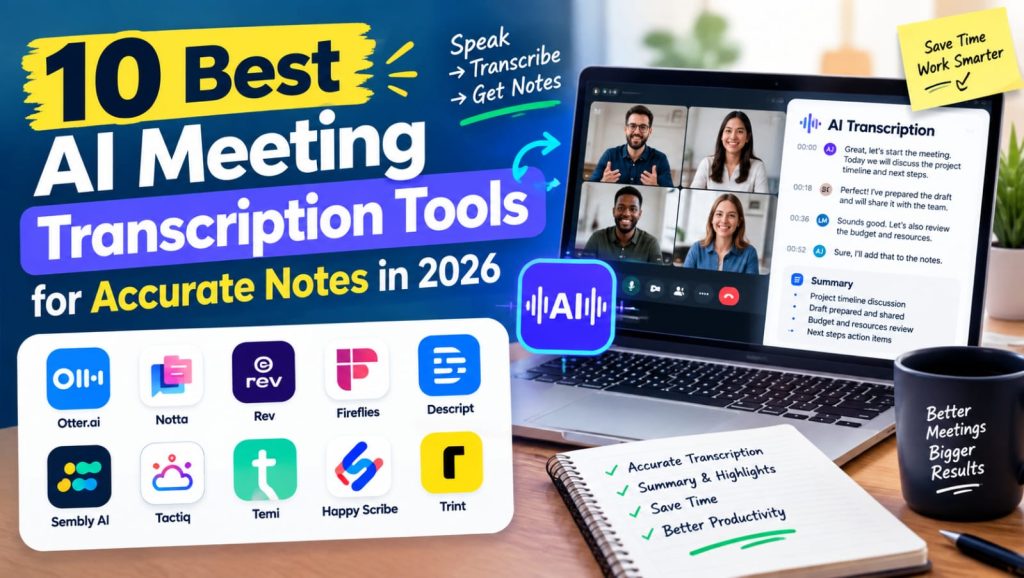
AI Meeting Transcription Tools have changed how teams capture conversations, decisions, and important details during online and in-person meetings. Instead of manually writing everything, these tools use speech recognition to convert spoken words into organized text within minutes.
AI Meeting Transcription Tools can also create summaries, identify speakers, highlight action items, and make meeting records searchable. In 2026, they are useful for businesses, students, sales teams, remote workers, researchers, and anyone who regularly attends meetings.
AI Meeting Transcription & Speech Recognition
AI Meeting Transcription Tools use automatic transcription and speech-to-text technology to convert meeting audio into written content. Modern AI speech recognition can process conversations in real time while recognizing punctuation, sentence structure, and important spoken words.
AI Meeting Transcription Tools can support real-time transcription, live transcription, voice-to-text conversion, and automated meeting notes. Their transcription accuracy depends on audio quality, language support, background noise, accents, and the underlying speech recognition technology.
Meeting Notes & Summaries
AI Meeting Transcription Tools can turn long conversations into concise meeting notes and useful meeting summaries. Instead of reviewing an entire recording, users can quickly read key takeaways, important points, and discussion highlights.
AI Meeting Transcription Tools can also generate AI-generated summaries that explain what happened during a meeting. These summaries may include a meeting recap, follow-up tasks, decisions, and conversation summaries, helping teams save time after every session.
Speaker Identification & Conversation Analysis
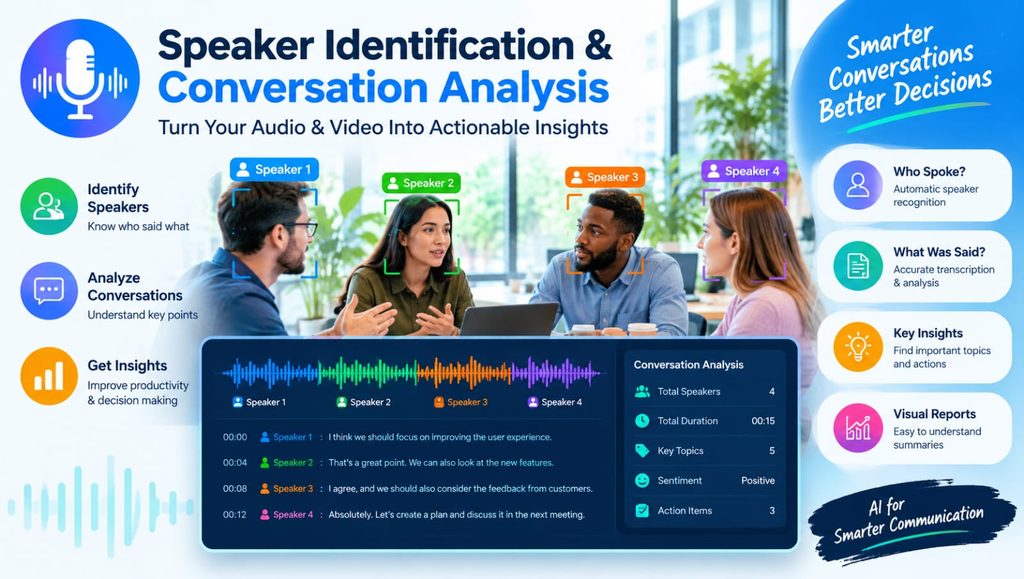
AI Meeting Transcription Tools can use speaker identification and speaker recognition to separate different participants. Speaker labels make transcripts easier to understand because readers can see which person made a specific statement.
AI Meeting Transcription Tools may also provide speaker diarization, participant identification, and conversation analysis. Multi-speaker transcription is particularly useful for team meetings, interviews, sales calls, and discussions where several people are talking.
Real-Time Meeting Assistance
AI Meeting Transcription Tools can work as a real-time meeting assistant by creating live meeting notes while a conversation is happening. Live transcription allows participants to focus on the discussion instead of constantly typing notes.
AI Meeting Transcription Tools can provide real-time insights and instant meeting summaries after important parts of a discussion. An automated note-taking system can act as a meeting companion that supports participants throughout virtual meetings.
AI-Powered Meeting Productivity
AI Meeting Transcription Tools can improve meeting productivity by reducing repetitive documentation work. Automated documentation allows employees to spend more time discussing projects, solving problems, and completing important responsibilities.
AI Meeting Transcription Tools can also support workflow automation and task automation. Meeting information can become structured notes, assigned tasks, and follow-up information, making these productivity tools useful for workplace productivity and team collaboration.
Meeting Platforms & Integrations
AI Meeting Transcription Tools commonly work with platforms such as Zoom meetings, Google Meet, and Microsoft Teams. These integrations allow users to capture conversations from popular online meetings and video conferencing services.
AI Meeting Transcription Tools may also offer calendar integration, browser extensions, Chrome extension support, and meeting assistant integrations. These features can simplify the process of joining, recording, transcribing, and organizing virtual meetings.
Audio & Video Transcription
AI Meeting Transcription Tools can convert audio-to-text from recorded meetings, voice recordings, and uploaded audio files. This is useful when users want to create written records from meetings that have already taken place.
AI Meeting Transcription Tools may also support video transcription and meeting recordings. Timestamped transcripts can connect written text with specific moments in video files, making media transcription and transcript navigation more convenient.
Search, Organization & Accessibility
AI Meeting Transcription Tools can create searchable meeting transcripts that allow users to find specific words or topics quickly. Keyword search and transcript search are particularly helpful when a meeting contains a large amount of information.
AI Meeting Transcription Tools can also organize meeting history into accessible records. Timestamps, transcript navigation, searchable conversations, and structured meeting documentation make it easier to return to older discussions when needed.
Action Items & Follow-Up
AI Meeting Transcription Tools can identify action items from conversations and help users understand what needs to happen next. Action item extraction can recognize tasks, responsibilities, deadlines, and important follow-up information.
AI Meeting Transcription Tools can support task identification and decision tracking after meetings. Assigned tasks and next steps can be organized into task summaries, helping teams maintain accountability and continue their post-meeting workflow.
Business & Team Collaboration
AI Meeting Transcription Tools are useful for different types of professional conversations, including team meetings, business meetings, sales meetings, and client meetings. They can create reliable documentation without requiring someone to manually record every detail.
AI Meeting Transcription Tools can also support interviews, brainstorming sessions, customer conversations, and remote teams. By creating shared meeting records, they can improve workplace communication and make team collaboration easier across different locations.
AI Meeting Assistant Features
AI Meeting Transcription Tools often include features associated with an AI meeting assistant and automated note taker. Intelligent transcription can capture conversations while AI-powered notes identify important information and produce organized documentation.
AI Meeting Transcription Tools may also provide meeting intelligence, conversation intelligence, contextual understanding, and automated summaries. These features help transform basic transcripts into useful meeting insights that teams can review after a conversation.
Transcription Quality & Language Support
AI Meeting Transcription Tools depend heavily on high-accuracy transcription and advanced natural language processing. Better systems can recognize different speaking patterns, punctuation, accents, and contextual meaning more effectively.
AI Meeting Transcription Tools may support multilingual transcription and multiple languages, making them suitable for international teams. Language support, accent recognition, speaker separation, and contextual transcription can all influence overall transcription quality.
Developer & API Terms
AI Meeting Transcription Tools can also be connected to software through a speech-to-text API or transcription API. Developers can use these technologies to add automated transcription, speech recognition, and audio processing features to their own applications.
AI Meeting Transcription Tools may use speech recognition APIs, real-time speech recognition, voice AI, language models, and speech processing technologies. These developer tools can help businesses build custom workflows around meetings, recordings, and conversational data.
Comparison Table of AI Meeting Transcription Tools
| Tool | Main Strength | Transcription | Summaries | Speaker Identification | Integrations |
|---|---|---|---|---|---|
| Otter.ai | Meeting notes | Yes | Yes | Yes | Zoom, Meet, Teams |
| Fireflies.ai | Meeting intelligence | Yes | Yes | Yes | Multiple platforms |
| Fathom | Meeting summaries | Yes | Yes | Yes | Video meeting platforms |
| Avoma | Sales meetings | Yes | Yes | Yes | CRM and meeting tools |
| tl;dv | Meeting recording | Yes | Yes | Yes | Zoom, Meet, Teams |
| Notta | Transcription | Yes | Yes | Yes | Online meetings |
| Read AI | Meeting insights | Yes | Yes | Yes | Major meeting platforms |
| Krisp | Voice and meeting tools | Yes | Yes | Limited/varies | Online meetings |
| Sembly AI | Meeting assistant | Yes | Yes | Yes | Meeting platforms |
| Grain | Conversation capture | Yes | Yes | Yes | Video meetings |
How to Choose the Right AI Meeting Transcription Tool
When choosing AI Meeting Transcription Tools, consider transcription accuracy, supported languages, speaker identification, summary quality, integrations, and pricing. A tool that performs well with clear audio may produce different results when conversations include background noise or multiple speakers.
It is also important to consider how meeting data is stored and accessed. Look for features such as searchable transcripts, timestamps, export options, collaboration tools, calendar integration, and API access if your workflow requires them.
Benefits of AI Meeting Transcription Tools
One major benefit of AI Meeting Transcription Tools is time savings. Instead of manually writing notes throughout a meeting, users can focus on listening and participating while the software handles transcription and documentation.
Another benefit is better access to meeting information. Searchable transcripts, summaries, action items, and timestamps make it easier to review previous conversations and locate important decisions without watching an entire recording again.
AI Meeting Transcription & Speech Recognition
AI Meeting Transcription Tools use AI speech recognition, automatic transcription, speech-to-text, and natural language processing to convert spoken words into accurate written text. These tools can provide real-time transcription, live transcription, voice-to-text conversion, and automated meeting notes, helping users capture important conversations without manually typing everything.
See more:AI Meeting Transcription Tools
Limitations to Consider
Even advanced AI Meeting Transcription Tools are not perfect in every situation. Strong background noise, overlapping conversations, unclear microphones, technical vocabulary, and unusual accents can affect transcription results.
Users should also review important transcripts before relying on them for critical decisions. AI-generated summaries can occasionally miss context or misunderstand a statement, so human verification remains useful for sensitive business, legal, academic, or professional information.
Frequently Asked Questions
1. What are AI Meeting Transcription Tools?
AI Meeting Transcription Tools are software applications that use artificial intelligence and speech recognition to convert spoken meeting conversations into written transcripts. Many tools can also create summaries, identify speakers, and extract action items.
2. Can AI meeting transcription work in real time?
Yes. Many modern AI Meeting Transcription Tools offer real-time or live transcription. This allows users to see spoken conversations converted into text while the meeting is taking place.
3. Which features should I look for?
Important features include transcription accuracy, speaker identification, multilingual support, searchable transcripts, AI summaries, action item extraction, meeting integrations, timestamps, and export options.
4. Can these tools work with Zoom and Google Meet?
Many AI Meeting Transcription Tools support popular meeting platforms such as Zoom, Google Meet, and Microsoft Teams. However, available integrations can differ between individual services and subscription plans.
5. Are AI meeting transcripts always accurate?
No transcription system is perfect. AI Meeting Transcription Tools can make mistakes when audio quality is poor, people speak over one another, or technical terms and accents are difficult to recognize. Reviewing important transcripts is recommended.

