
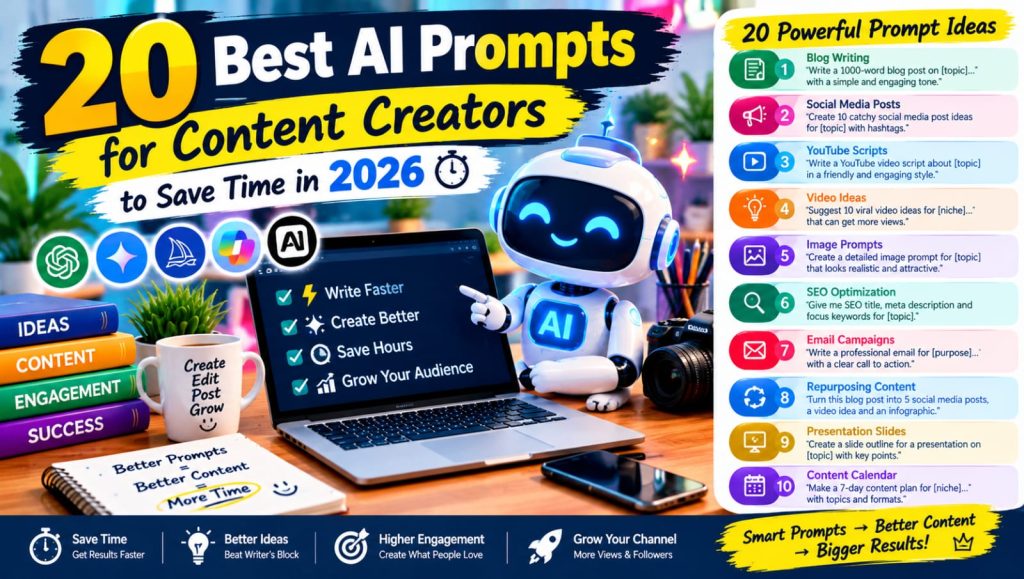
AI Prompts for Content Creators help bloggers, YouTubers, social media managers, and digital marketers create better content in less time. With the right prompts, you can generate fresh ideas, write engaging captions, plan blog posts, prepare video scripts, and organize your publishing schedule. Instead of starting every project from scratch, you can use AI tools to simplify repetitive tasks and focus on creating valuable content for your audience.
In 2026, successful content creation requires creativity, consistency, and a clear understanding of your audience. AI can support every stage of the process, from brainstorming and research to editing and publishing. The following prompts are designed to help creators save time, maintain their brand voice, and produce useful content across multiple platforms without sacrificing quality or originality.
Core Keywords & Related Search Terms
AI Prompts for Content Creators, AI content creation prompts, ChatGPT prompts for content creators, best AI prompts for creators, content creator prompts, AI writing prompts, content creation with AI, AI-powered content creation, creative writing prompts, copy-and-paste AI prompts, AI prompt templates, content generation prompts, AI tools for creators, generative AI for content creation, AI content workflow, content creation ideas.
Social Media Content Prompts
Social media creators need fresh ideas, attractive captions, and engaging hooks to connect with their audiences. AI Prompts for Content Creators can help generate Instagram posts, TikTok videos, LinkedIn updates, Facebook content, and X threads. By specifying your platform and target audience, you can create content that matches your brand and encourages meaningful engagement.
Prompt: Social Media Content Ideas
“Act as a social media strategist. Generate 10 original post ideas for [niche] targeting [audience]. Include a catchy hook, caption, recommended format, and call to action for each idea. Keep the suggestions practical, engaging, and suitable for [platform].”
Prompt: Instagram Captions
“Write five engaging Instagram captions about [topic]. Use a natural tone, an interesting opening, relevant keywords, and a clear call to action. Suggest suitable hashtags and avoid repetitive phrases or exaggerated claims.”
Blog Writing & Article Creation Prompts
Bloggers can use AI to develop article ideas, organize headings, prepare outlines, and improve introductions. These prompts are useful for maintaining a consistent publishing schedule and covering topics that answer readers’ questions. Always add original insights, reliable information, and examples to make your articles more valuable.
Prompt: SEO Blog Outline
“Act as an experienced blog writer and SEO editor. Create a detailed outline for [topic] targeting [audience]. Include search intent, a compelling introduction, relevant H2 and H3 headings, practical examples, frequently asked questions, and a conclusion. Avoid unnecessary sections and keyword stuffing.”
Prompt: Article Introduction
“Write two short introduction paragraphs for an article titled [title]. Start with the focus keyword [keyword], explain the reader’s main problem, and describe what they will learn. Use clear, conversational English and avoid generic statements.”

YouTube & Video Creation Prompts
Video creators need strong openings, organized scripts, and interesting ideas to hold viewers’ attention. AI can help prepare YouTube videos, Shorts, TikTok scripts, and Instagram Reels. These prompts provide a useful structure while leaving room for the creator’s personality, examples, and storytelling.
Prompt: YouTube Video Script
“Act as a professional YouTube scriptwriter. Write a script about [topic] for [audience]. Start with a compelling hook, explain the main benefit, organize the information into clear sections, include examples, and finish with a natural call to action. Make the script conversational and easy to speak aloud.”
Prompt: Short-Form Video Ideas
“Generate 10 short-form video ideas for [niche]. For each idea, provide a three-second hook, video concept, three talking points, and closing line. Focus on original, useful ideas that can be filmed using [available resources].”
Content Repurposing & Multi-Platform Publishing
Repurposing turns one piece of content into several formats, helping creators reach audiences on different platforms. For example, a blog post can become an Instagram carousel, a LinkedIn post, a newsletter, or a short video. This approach reduces repetitive work while allowing creators to share their ideas more widely.
Prompt: Repurpose Existing Content
“Transform the following content into an Instagram caption, LinkedIn post, short video script, email newsletter, and X thread. Adapt each version to the platform while preserving the original message. Make every version useful as standalone content. Source: [paste content].”
Prompt: Convert Video Into a Blog
“Turn this video transcript into an informative blog article. Create a suitable title, introduction, organized headings, key takeaways, and conclusion. Remove unnecessary repetition, preserve the original meaning, and identify claims that require fact-checking. Transcript: [paste transcript].”
Content Ideas, Brainstorming & Creativity
Coming up with fresh topics can become difficult when publishing regularly. AI brainstorming can help creators explore audience questions, new content angles, trending discussions, and overlooked subjects. The strongest ideas combine AI suggestions with real audience feedback and the creator’s own experience.
Prompt: Generate Content Ideas
“Act as a creative content strategist specializing in [niche]. Generate 20 useful content ideas for [audience]. Include educational, entertaining, problem-solving, and opinion-based topics. Explain the value of each idea and recommend a suitable format. Avoid broad or repetitive suggestions.”
Prompt: Discover Audience Problems
“Identify common challenges and questions that [audience] may have about [topic]. Organize them by beginner, intermediate, and advanced levels. Suggest one content idea for each challenge and explain what practical information the content should include.”
SEO & Content Optimization Prompts
SEO helps creators organize information around what users are searching for. AI can support keyword planning, title creation, content structure, and readability improvements. However, keyword suggestions should be checked for relevance, and no prompt can guarantee search rankings.
Prompt: Optimize Blog Content
“Act as an SEO content editor. Review this article for search intent, readability, heading structure, topical coverage, and missing information. Suggest relevant semantic keywords naturally and recommend helpful improvements without keyword stuffing. Target keyword: [keyword]. Article: [paste article].”
Prompt: SEO Titles and Meta Descriptions
“Create 10 SEO title options and five meta descriptions for [topic]. Use the focus keyword [keyword] naturally, accurately describe the content, and encourage relevant clicks. Avoid clickbait, unsupported promises, and repetitive wording.”
Brand Voice, Tone & Writing Style
A consistent brand voice makes content recognizable across websites, newsletters, and social media. AI can adapt writing to a friendly, professional, educational, or conversational style. Providing clear guidelines and writing examples helps maintain consistency.
Prompt: Create a Brand Voice Guide
“Create a brand voice guide for [brand] targeting [audience]. Define the personality, preferred vocabulary, tone, sentence style, and communication principles. Include five phrases to use, five phrases to avoid, and three examples that demonstrate the desired voice.”
Prompt: Improve Writing Style
“Rewrite the following draft in a natural, clear, and engaging style for [audience]. Preserve the meaning, improve transitions, remove repetition, and vary sentence structure. Do not invent facts or personal experiences. Draft: [paste text].”
Email, Newsletter & Podcast Prompts
Email newsletters and podcasts help creators build stronger relationships with their audiences. AI can generate subject lines, episode outlines, interview questions, and newsletter drafts. Sharing the intended audience and goal makes the output more relevant and useful.
Prompt: Write an Email Newsletter
“Write a newsletter about [topic] for subscribers interested in [niche]. Provide five subject lines, a short introduction, three useful takeaways, and a relevant call to action. Use a friendly tone and base factual statements on these notes: [paste notes].”
Prompt: Plan a Podcast Episode
“Create a podcast outline about [topic] for [audience]. Include an engaging opening, five discussion questions, useful examples, potential interview questions, and a closing summary. Suggest an episode title and description.”
Content Marketing & Audience Growth
Content marketing helps creators build awareness, attract relevant audiences, and promote products or services. AI can assist with campaign planning, personal branding, promotional posts, and sponsorship proposals. Successful content should communicate genuine value rather than relying on exaggerated promises.
Prompt: Create a Content Marketing Plan
“Develop a 30-day content marketing plan for [brand] targeting [audience]. Include weekly themes, platforms, content formats, calls to action, and measurable performance indicators. Balance educational, entertaining, community-building, and promotional content.”
Prompt: Write a Sponsorship Pitch
“Write a professional sponsorship proposal for [creator] to approach [brand]. Introduce the creator, explain audience relevance, suggest collaboration ideas, and outline potential deliverables. Use placeholders for audience statistics and previous results. Never invent performance data.”
Productivity & AI Content Workflows
A clear content workflow helps creators manage deadlines, batch similar tasks, and publish consistently. Reusable prompts can organize weekly calendars, simplify editing, and reduce the time spent planning individual posts. Human review should remain part of the process.
Prompt: Build a Weekly Content Calendar
“Create a seven-day content calendar for [niche] targeting [audience]. Include a daily topic, platform, format, hook, main takeaway, and call to action. Balance educational, entertaining, and community-focused content. Make the schedule realistic for someone with [available hours] per week.”
AI Tools & Prompt Engineering
AI tools such as ChatGPT, Claude, and Gemini can assist with writing, brainstorming, editing, and planning. Results depend on the instructions and context provided. Effective prompts explain the role, task, audience, limitations, and expected output.
Prompt: Create a Reusable Master Prompt
“Act as my content creation assistant for [niche]. My audience is [audience], my brand voice is [tone], and my goal is [goal]. When I provide a topic, suggest three content angles, create an outline, draft the content in [format], and recommend improvements. Identify uncertain facts and never invent sources or statistics.”

Content Creator Business & Monetization
Creators can use AI to prepare media kits, freelance proposals, affiliate content, product descriptions, and brand partnership emails. Templates save time on repeated business tasks while helping creators communicate professionally. Include accurate information about your experience, services, and audience.
For monetization, focus on products and services that genuinely benefit your audience. Clearly disclose sponsored relationships where required, verify product claims, and avoid fabricated testimonials or results. AI can assist with the wording, but business decisions and final approvals should remain yours.
See more:AI Prompts for Content Creators
Long-Tail Keywords for Natural SEO Integration
Long-tail keywords describe specific search needs and can help creators plan relevant article sections. Examples include best AI prompts for content creators, ChatGPT prompts for social media content, AI prompts for writing blog posts, AI prompts for YouTube video scripts, and AI prompts for Instagram captions.
Comparison Table: Best Prompts for Different Content Tasks
| Content task | Recommended prompt | Main benefit |
|---|---|---|
| Social media | Instagram captions | Faster post creation |
| Blogging | SEO blog outline | Better structure |
| YouTube | Video script | Organized storytelling |
| Repurposing | Convert existing content | Multiple formats |
| Brainstorming | Generate content ideas | Fresh topics |
| SEO | Optimize blog content | Better relevance |
| Branding | Brand voice guide | Consistent tone |
| Newsletters | Email newsletter | Faster drafting |
| Marketing | Content marketing plan | Organized campaigns |
| Productivity | Weekly calendar | Consistent publishing |
How to Get the Best Results From AI Prompts
Start with a specific goal and explain your audience, topic, platform, tone, and preferred format. Add examples when you want a particular writing style. Replace every placeholder with relevant details before submitting a prompt.
Review the first draft and request targeted improvements instead of restarting the entire task. Ask AI to clarify explanations, improve transitions, suggest examples, or shorten unnecessary sections. Use the results as a starting point, then verify information and add original insights.
Frequently Asked Questions
What are AI Prompts for Content Creators?
They are instructions that guide AI tools to generate, organize, or improve content, including articles, captions, scripts, newsletters, and marketing materials.
Can beginners use AI prompts?
Yes. Beginners can replace the placeholders with their topic, audience, and goals. Clear instructions help produce more relevant results.
Which AI tools are useful for content creation?
ChatGPT, Claude, and Gemini can assist with brainstorming, outlining, writing, and editing. The best option depends on your needs, budget, and preferred workflow.
Can AI-generated content rank on Google?
AI-assisted content can rank when it is helpful, accurate, original, and relevant to users. Using AI does not guarantee rankings.
How do AI prompts save time?
They provide reusable instructions for common tasks, reduce repetitive planning, speed up first drafts, and help creators organize content more efficiently.

