
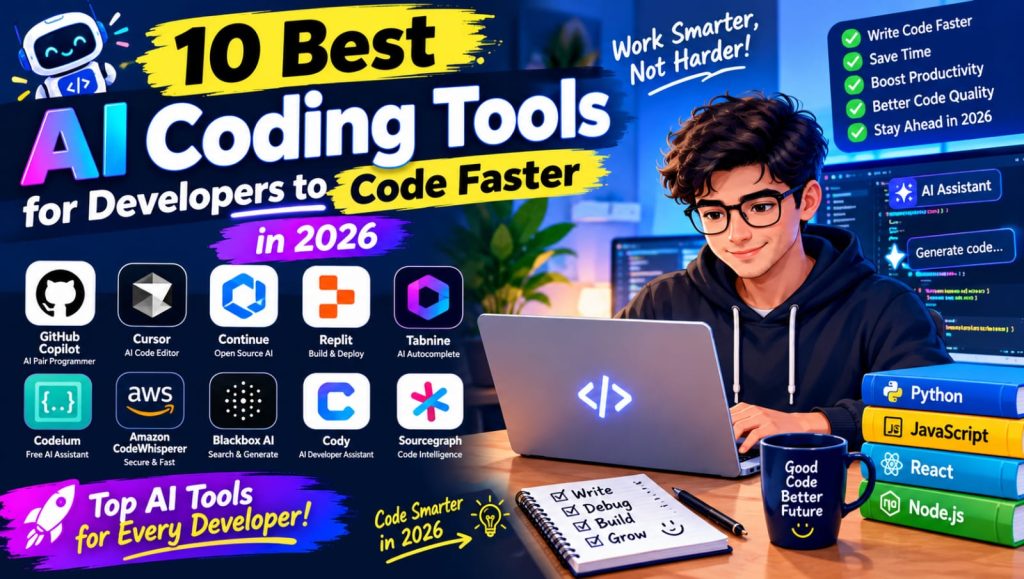
AI Coding Tools are changing the way developers write, test, debug, and maintain software. Modern developers can use intelligent coding assistants to generate code, complete functions, explain errors, create tests, and automate repetitive development tasks.
AI Coding Tools also make software development faster by combining code generation, natural language prompts, debugging assistance, codebase understanding, and AI-powered development workflows. Whether you are a beginner, professional developer, or part of an enterprise team, these tools can improve coding productivity.
Coding Tools — Core Semantic Terms
AI Coding Tools include AI coding assistants, AI programming tools, AI developer tools, and AI software development tools designed to support different stages of software engineering. They use artificial intelligence coding techniques to provide contextual suggestions and automate repetitive programming work.
Modern AI Coding Tools support AI-assisted programming, coding automation, automated programming, and intelligent coding assistants. They can become part of an AI development workflow and help developers improve developer productivity, programming productivity, and overall software development automation.
Code Generation & Completion
AI Coding Tools can generate code from natural language instructions, making AI code generation useful for creating functions, classes, components, and complete code snippets. Developers can describe what they need and receive code suggestions within their development environment.
Code completion is another important feature of AI Coding Tools. Intelligent code completion, autocomplete, real-time code suggestions, prompt-to-code, text-to-code, and multi-line code completion can reduce manual typing and speed up implementation.
Code Editing & Refactoring
AI Coding Tools can also work as an AI code editor or AI-powered IDE. Developers can request inline code editing, code rewriting, code transformation, and contextual code changes without manually modifying every part of a project.
For large projects, AI Coding Tools can assist with automated refactoring, code cleanup, code restructuring, and multi-file refactoring. These capabilities are useful for legacy code modernization, code optimization, and maintaining cleaner codebases.

Debugging & Testing
AI Coding Tools can help developers identify programming problems through AI debugging, error detection, bug detection, and code analysis. Instead of searching manually for every issue, developers can ask an assistant to explain an error and suggest possible fixes.
Testing is another major benefit of AI Coding Tools. They can assist with automated testing, unit test generation, test case generation, and test automation while also supporting vulnerability detection, security remediation, and code quality analysis.
AI Agents & Autonomous Coding
AI Coding Tools increasingly include coding agents that can perform multi-step development tasks. AI coding agents can understand a task, create an implementation plan, modify files, run commands, and make changes across a project.
With agentic coding, AI Coding Tools can support autonomous coding, task automation, automated implementation, autonomous debugging, and end-to-end development. This allows developers to delegate repetitive or complex coding workflows while maintaining control over the final result.
Codebase & Context Understanding
AI Coding Tools are becoming better at understanding complete projects instead of looking at only one file. Codebase understanding allows an assistant to analyze project context, repository structure, dependencies, and related files before suggesting changes.
For large applications, AI Coding Tools can provide codebase indexing, repository analysis, project-wide context, dependency analysis, code navigation, and repository mapping. Context-aware AI can produce more relevant suggestions based on the existing architecture.
AI Chat & Natural Language Coding
AI Coding Tools often include an AI coding chat where developers can ask programming questions using natural language. This conversational programming approach makes it easier to request code explanations, documentation, debugging help, and implementation ideas.
Developers can use AI Coding Tools through natural language prompts and commands. A coding chatbot can explain unfamiliar code, answer technical questions, suggest solutions, and provide interactive coding assistance without requiring developers to search through multiple resources.
IDEs, Editors & Development Environments
AI Coding Tools work across many development environments, including AI IDEs, Visual Studio Code, JetBrains IDEs, Xcode, Neovim, terminals, and browser-based coding platforms. Editor integration makes AI assistance available directly inside the coding workflow.
Modern AI Coding Tools can also support CLI development, cloud development environments, web-based IDEs, IDE extensions, and coding plugins. This flexibility lets developers choose an environment that matches their preferred programming workflow.
Programming Languages & Frameworks
AI Coding Tools can assist with popular programming languages such as Python, JavaScript, TypeScript, Java, C++, C#, Go, Rust, PHP, Swift, and Kotlin. Developers can use them for syntax assistance, code generation, debugging, and framework-specific development.
Framework support is equally important for AI Coding Tools. Developers can use AI assistance for React, Next.js, Node.js, frontend development, backend development, full-stack development, web development, and mobile app development.
AI Coding for Web & App Development
AI Coding Tools make AI web development and AI app development more accessible. Developers can describe an application idea and use natural language to generate frontend code, backend code, UI elements, APIs, and application structures.
For rapid prototyping, AI Coding Tools can help create web apps, mobile apps, interactive prototypes, and production-ready applications. Some platforms also provide live preview and one-click deployment features that shorten the path from an idea to a working product.
AI UI & Design Development
AI Coding Tools can connect coding with AI UI generation and AI-powered design. Developers can create frontend layouts, UI components, responsive interfaces, and visual prototypes using natural language instructions.
Design-to-code workflows make AI Coding Tools useful for product designers and frontend developers. AI can help turn design concepts into code while supporting polished UI, UX development, responsive design, component generation, and digital product development.
Git, GitHub & Version Control
AI Coding Tools can integrate with Git and GitHub to improve version control workflows. Developers can receive help with repository management, Git operations, code review, pull requests, commit messages, and understanding changes.
For development teams, AI Coding Tools can support collaborative coding and team coding workflows. AI code review and pull request summaries can reduce repetitive documentation work and help developers understand project changes more quickly.
Documentation & Code Explanation
AI Coding Tools can automatically generate documentation from existing code. They can assist with README generation, API documentation, inline documentation, code comments, technical documentation, and developer documentation.
Code explanation is another useful capability of AI Coding Tools. Developers can ask an assistant to explain complex functions, describe codebase behavior, summarize implementation details, or convert technical information into easier documentation.
APIs, Integrations & Automation
AI Coding Tools can support API development and API integration by helping developers create endpoints, authentication logic, database connections, webhooks, and third-party integrations. This can simplify repetitive development workflows.
Developers can also use AI Coding Tools for workflow automation and AI-powered workflows. They can generate integration code, transform data, connect external services, and automate common development processes.
Large Language Models & AI Models
AI Coding Tools rely on large language models, coding LLMs, generative AI, and code-focused LLMs to understand programming instructions. Different models can have different strengths in reasoning, code generation, debugging, and context handling.
Many AI Coding Tools support model selection, GPT models, Claude models, Gemini models, DeepSeek models, local AI models, and custom AI models. Some also provide BYOK options, allowing developers to bring their own API key.
Developer Productivity & Workflow
AI Coding Tools can improve developer productivity by reducing repetitive work and helping programmers move from ideas to implementation faster. Code generation, autocomplete, debugging, testing, and documentation can all contribute to coding efficiency.
The main goal of AI Coding Tools is not simply to write more code but to streamline the developer workflow. Faster development, rapid prototyping, reduced development time, and automated workflows can help teams focus more on problem-solving and product quality.
Security, Privacy & Reliability
AI Coding Tools should be evaluated carefully for AI code security, data privacy, secure coding, and production reliability. Developers should understand how their code is processed and whether the platform provides suitable security controls.
Reliable AI Coding Tools may offer vulnerability scanning, security analysis, security remediation, access control, authentication, authorization, and privacy-focused coding features. Enterprise users may also look for zero code retention and local AI model support.
Team & Enterprise Development
AI Coding Tools are increasingly used by professional developer teams and enterprise organizations. Team-focused features can include centralized management, policy management, knowledge base integration, collaborative coding, and enterprise security controls.
For larger organizations, AI Coding Tools may provide custom AI models, private deployment, VPC deployment, role-based access control, and enterprise code assistants. These features can help organizations introduce AI-assisted development while maintaining internal security policies.
Beginner-Friendly AI Coding
AI Coding Tools are not limited to experienced programmers. Beginners can use AI coding assistants to learn programming concepts, generate simple code, understand errors, and experiment with application ideas without extensive coding experience.
For new developers, AI Coding Tools can support prompt-based coding, visual development, browser-based development, AI website builders, and AI app builders. These features can make coding more approachable for students and citizen developers.

AI Coding Tools — Comparison Terms
When comparing the AI Coding Tools, developers should consider code generation, code completion, debugging, agent capabilities, IDE integration, supported programming languages, codebase context, security, pricing, and collaboration features.
The best AI Coding Tools depend on the developer’s requirements. Some are ideal for individual programmers, while others are better suited to teams and enterprise environments. Free AI coding tools can be useful for beginners, while paid platforms may offer advanced features.
| Tool Type | Best For | Key Features |
|---|---|---|
| AI Coding Assistant | Everyday coding | Code completion, suggestions, explanations |
| AI Code Editor | Advanced development | Editing, refactoring, multi-file changes |
| AI Coding Agent | Complex tasks | Autonomous coding, planning, debugging |
| AI Code Generator | Rapid development | Natural language to code, boilerplate |
| AI IDE | Full development workflow | Coding, testing, debugging, context |
| AI Code Review Tool | Teams | Code review, security analysis, pull requests |
| AI App Builder | Beginners | Prompt-based development, UI generation |
| AI Debugging Assistant | Error fixing | Bug detection, error explanation, fixes |
| AI Documentation Tool | Technical writing | README, comments, API documentation |
| Enterprise AI Assistant | Large teams | Security, policies, private deployment |
How to Choose the Right AI Coding Tool
Start by identifying your development needs. If you mainly want autocomplete and code suggestions, an AI coding assistant may be enough. If you work on large repositories, prioritize codebase understanding, multi-file context, and advanced code navigation.
You should also compare pricing, supported languages, IDE integration, security, privacy, model selection, and team features. The right tool should fit your existing development workflow rather than forcing you to completely change how you build software.
See more:AI Coding Tools
Benefits of AI Coding Tools
One of the biggest advantages of AI Coding Tools is faster development. They can reduce repetitive programming tasks, generate boilerplate, explain unfamiliar code, and provide suggestions while developers work.
Another benefit is improved accessibility. AI Coding Tools can help beginners learn programming and allow experienced developers to spend more time on architecture, product decisions, testing, and complex problem-solving instead of repetitive coding.
FAQs
1. What are AI Coding Tools?
AI Coding Tools are software development platforms and assistants that use artificial intelligence to help developers write, understand, debug, test, refactor, and document code.
2. Are AI Coding Tools useful for beginners?
Yes. AI Coding Tools can help beginners generate simple code, understand programming concepts, explain errors, and learn through natural language prompts.
3. Can AI Coding Tools replace developers?
No. AI Coding Tools can automate many programming tasks, but developers are still needed for architecture, security decisions, testing, requirements, code review, and final validation.
4. Which programming languages work with AI coding assistants?
Most modern AI Coding Tools support popular languages such as Python, JavaScript, TypeScript, Java, C++, C#, Go, Rust, PHP, Swift, and Kotlin, although support varies between platforms.
5. Are AI Coding Tools safe for professional projects?
They can be used professionally, but developers should check each platform’s privacy, security, data retention, access control, and enterprise policies before using it with sensitive or proprietary code.

