

AI Data Analytics Tools help businesses, marketers, researchers, and professionals transform raw data into meaningful insights. These tools use artificial intelligence to identify patterns, analyze large datasets, automate repetitive tasks, and explain complex information in simple language.
Whether you work with Excel spreadsheets, Google Sheets, databases, or business dashboards, the right platform can make data analysis faster and easier. In this guide, we explore popular solutions, their main features, practical uses, and how to choose the right option for your needs.
AI Data Analytics Tools — Core Semantic Terms
Modern analytics software combines artificial intelligence, machine learning, and statistical techniques to understand business information. These platforms support intelligent data analysis, automated data analytics, predictive data analysis, and AI-driven insights without requiring users to perform every calculation manually.
Businesses can use data intelligence software to discover opportunities, identify performance problems, and improve planning. Depending on the platform, users can upload files, ask questions in natural language, create reports, and explore trends through interactive visualizations.
AI-Powered Data Analysis Features
AI-powered analytics can automate data processing, detect unusual values, identify patterns, and generate summaries from complex datasets. Predictive modeling and statistical forecasting can also help organizations estimate future demand, understand customer behavior, and recognize emerging business trends.
Another useful feature is conversational analytics, which allows users to ask questions in everyday language. Instead of manually examining every row, users can request summaries, comparisons, or charts and then verify the generated results before making important decisions.
AI Spreadsheet Tools — Excel and Google Sheets
AI spreadsheet assistants help users clean datasets, generate formulas, summarize tables, and organize information in Excel and Google Sheets. Microsoft Copilot for Excel and Gemini in Google Sheets can support spreadsheet workflows, although their capabilities depend on the subscription, account, and available features.
Users can also analyze spreadsheet data with ChatGPT or dedicated tools such as Julius AI. These solutions are useful for financial calculations, sales reports, automated spreadsheet reporting, and chart creation. Always check formulas and calculations before using the results in business reports.

Free AI Data Analytics Tools
Several platforms offer free access, limited trials, or free usage tiers for exploring datasets. ChatGPT, Google Sheets, Power BI, and other analytics products may provide useful entry points, but the available AI features and usage limits vary by plan and region.
Free AI data analysis tools are particularly helpful for students, freelancers, and small businesses with limited budgets. Before uploading a file, review the platform’s data limits, export options, privacy settings, and restrictions. A free plan may be enough for small projects but unsuitable for large or frequent workloads.
Business Intelligence and Data Visualization
Business intelligence platforms transform business metrics into dashboards, charts, and reports that are easier to understand. Microsoft Power BI and Tableau help teams monitor key performance indicators, compare results, and explore relationships between sales, marketing, customer behavior, and operational performance.
Visual reporting is valuable because it makes complicated information easier to communicate. With AI-assisted explanations and automated dashboards, teams can spend less time preparing presentations and more time investigating meaningful changes in performance.
See more:AI Data Analytics Tools
Predictive Analytics and Machine Learning
Predictive analytics uses historical information, statistical methods, and machine learning to estimate possible future outcomes. Organizations can apply these techniques to demand forecasting, sales projections, customer segmentation, risk assessment, and customer churn prediction.
Platforms such as Google BigQuery ML and other machine learning environments help analysts build or use predictive models. However, forecasts are estimates rather than guarantees. Reliable predictions require relevant data, suitable models, and regular evaluation against actual results.
AI Tools for Data Cleaning and Preparation
Data preparation is an essential step because missing values, duplicated records, inconsistent formats, and incorrect entries can produce misleading conclusions. AI-assisted data cleaning tools can identify potential errors, categorize information, standardize values, and help prepare datasets for analysis.
Before generating reports, users should review the cleaned dataset and confirm that important records have not been removed or changed incorrectly. Good data quality management improves consistency and makes subsequent analysis more dependable, especially when information comes from multiple sources.
Natural Language Processing and SQL Analytics
Natural language analytics allows users to ask questions about databases without writing every query manually. AI SQL query generators can translate plain-language requests into SQL statements, explain existing queries, and help users explore tables more efficiently.
These capabilities can benefit teams working with customer databases, data warehouses, and large business datasets. Nevertheless, generated queries should be checked for correct table names, filters, joins, and calculations. Database permissions and read-only access can also help reduce the risk of accidental changes.
Big Data and Cloud Analytics Platforms
Cloud analytics platforms allow organizations to process and analyze information without managing every part of the underlying infrastructure themselves. Google BigQuery, Google Cloud analytics services, and other cloud-based systems support scalable data processing, data warehouse analytics, and integration with machine learning workflows.
These platforms are useful when datasets grow beyond the practical limits of ordinary spreadsheets. Businesses should compare processing costs, storage requirements, access controls, and integration options before selecting a cloud environment for ongoing analytics projects.
Popular AI Data Analytics Tools and Platforms
The best platform depends on the type of data you use and the results you need. ChatGPT can assist with uploaded data analysis, Julius AI offers a conversational approach to data exploration, and Microsoft Copilot supports eligible Microsoft productivity workflows.
Power BI and Tableau are strong options for business dashboards and visual reporting, while Google BigQuery is designed for large-scale data analysis. Google Gemini and Claude can also assist with supported analytical tasks. Feature availability, integrations, and pricing should be checked on the providers’ official websites.
AI Analytics Use Cases for Businesses
Businesses can use analytics to examine sales performance, evaluate marketing campaigns, understand customer feedback, and monitor inventory. E-commerce stores may analyze product demand, while service providers can investigate customer satisfaction and identify operational bottlenecks.
Financial teams can use these systems to summarize expenses and compare revenue trends. Marketing teams can measure campaign performance, and managers can monitor key business metrics. Any automated recommendation should be reviewed alongside relevant business context before it influences a major decision.
Benefits of AI Data Analytics Tools
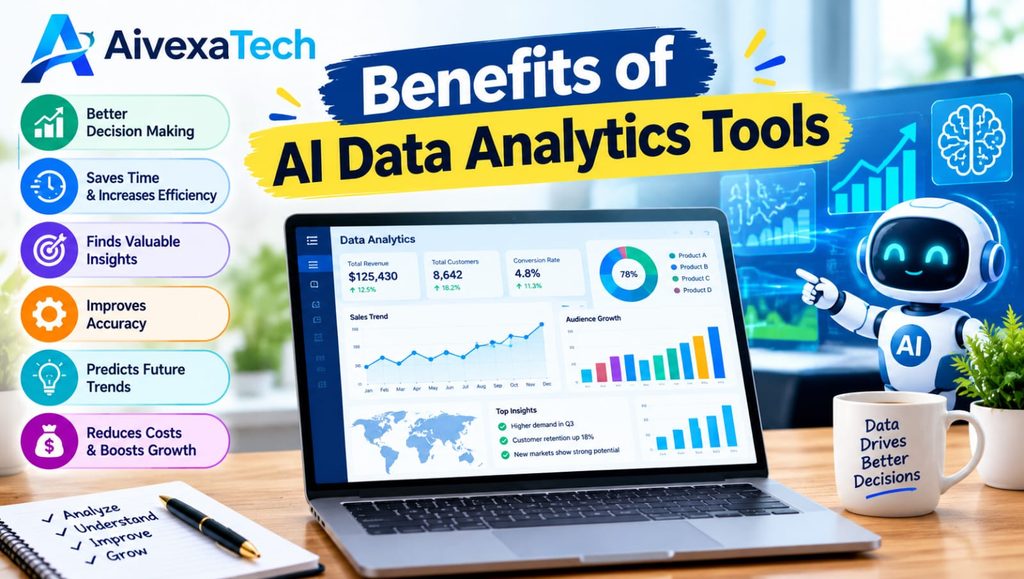
Automation reduces the time spent on repetitive calculations, routine reporting, and initial data exploration. AI can make complex datasets easier to understand by summarizing patterns, suggesting visualizations, and helping nontechnical users investigate business questions.
Other benefits include faster reporting workflows, more accessible data exploration, and support for better forecasting. However, these advantages depend on data quality and appropriate use. Human review remains important because AI-generated explanations can contain errors, overlook context, or present uncertain findings too confidently.
AI Data Analytics Tools — Comparison and Selection Keywords
When comparing analytics platforms, consider ease of use, supported file formats, AI features, integrations, security, and total cost. Some products are better suited to spreadsheets, while others focus on enterprise dashboards, SQL queries, or large cloud datasets.
Choose a solution that matches your team’s technical skills and reporting requirements. Test it with a representative dataset, verify the accuracy of its results, and review its data-handling policies before committing to a paid subscription.
AI Data Analytics Tools Comparison Table
| Tool | Best For | Main Strength | Pricing Consideration |
|---|---|---|---|
| ChatGPT | Exploring and summarizing data | Conversational analysis | Free and paid options may vary |
| Microsoft Copilot for Excel | Spreadsheet workflows | Formula and data assistance | Eligible Microsoft plans and features |
| Google Gemini | Google productivity workflows | Assistance with supported Google tools | Availability depends on account and plan |
| Julius AI | Conversational data analysis | Data exploration and visualization | Check current plan limits |
| Microsoft Power BI | Business intelligence | Interactive dashboards | Free and paid offerings |
| Tableau | Advanced visualization | Interactive data exploration | Check current licensing |
| Google BigQuery | Large datasets | Scalable cloud analytics | Usage-based costs may apply |
| Claude | Data interpretation and coding assistance | Explanations and analytical support | Free and paid options may vary |
| GPT for Work | Spreadsheet and document workflows | AI-assisted repetitive tasks | Check current plans and integrations |
| Google Looker | Business intelligence | Governed reporting and exploration | Pricing depends on the offering |
The table provides a general comparison rather than a fixed ranking. Product capabilities, free access, and pricing can change, so confirm current details with each provider before choosing a platform.
How to Choose the Right Analytics Platform
Start by identifying your primary task. If you mainly work with spreadsheets, choose a tool that supports your existing workflow. If you need recurring business reports, prioritize dashboards, data connections, and scheduled reporting.
For large datasets, evaluate cloud processing capabilities and query costs. For sensitive information, review retention policies, access controls, and available privacy protections. A small practical test can help you compare accuracy, usability, and time savings before adopting a platform across your organization.
See more:AI Data Analytics Tools
Final Thoughts
The right analytics platform can make data exploration more accessible, reduce repetitive work, and help teams discover useful patterns. The most suitable option depends on your budget, dataset size, technical experience, and preferred workflow.
Start with a clear business question, use reliable data, and verify important calculations before acting on the findings. Comparing features and testing real tasks will help you select a solution that supports informed, data-driven decisions.
Frequently Asked Questions
1. What are AI data analytics tools?
These are software applications that use artificial intelligence, machine learning, or related techniques to analyze datasets, identify patterns, generate summaries, and support data-driven decisions.
2. Which AI analytics tool is best for beginners?
ChatGPT, spreadsheet-based assistants, and conversational analytics platforms can be useful starting points. The best choice depends on your file formats, budget, and the features available in your account.
3. Are there free AI data analysis tools?
Yes. Some platforms offer free plans or limited access. However, upload limits, advanced features, AI usage, and export options may require a paid subscription.
4. Can AI analyze Excel and CSV files?
Many AI-enabled tools support Excel or CSV analysis, depending on their current features and account limits. Always verify the calculations and check whether the uploaded information has been interpreted correctly.
5. Is AI data analysis accurate?
AI can help identify trends and automate analytical tasks, but it is not always accurate. Incorrect data, unsuitable methods, and misunderstood instructions can produce misleading results, so important findings should be independently checked.

