
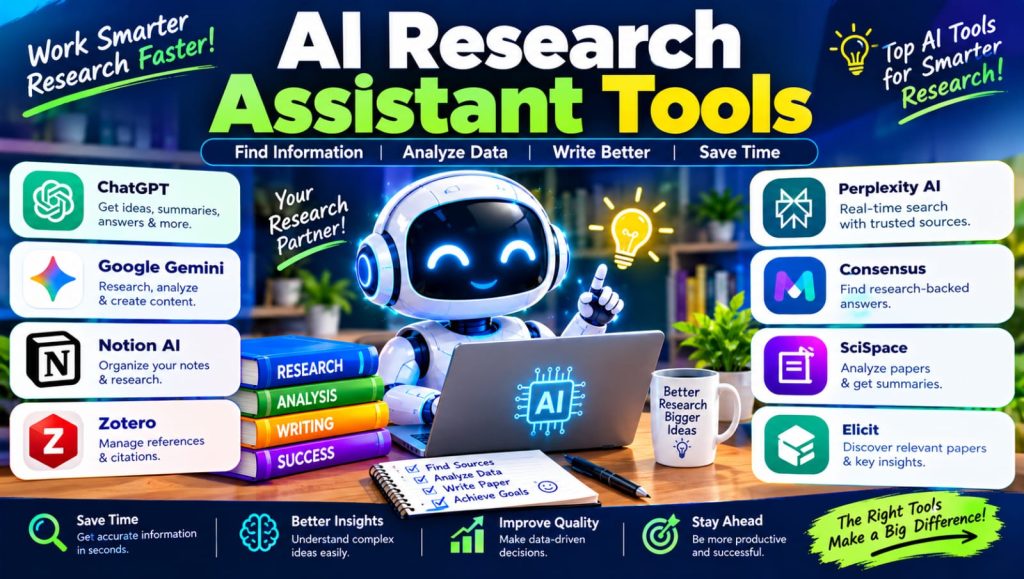
AI Research Assistant Tools help simplify this process by using artificial intelligence to discover information, summarize complex sources, organize notes, identify useful references, and support researchers throughout their projects.
Whether you are a student, teacher, content creator, academic researcher, journalist, or professional, these tools can make research faster and more organized. Instead of spending hours performing repetitive searches and sorting information, you can use AI-powered platforms to find relevant information and focus more on analysis, critical thinking, and producing high-quality work.
What Are AI Research Assistant Tools?
AI Research Assistant Tools are software applications that use artificial intelligence to support different stages of the research process. They can help users search for information, understand academic literature, summarize documents, generate research ideas, organize references, and extract important points from large amounts of text.
Traditional research often requires visiting multiple websites and reading lengthy documents individually. AI-powered research assistants can reduce this workload by processing information quickly and presenting useful findings in a structured format. However, researchers should still verify important information and consult original sources before using it in academic or professional work.
How AI Research Assistants Help Researchers
One of the biggest advantages of AI Research Assistant Tools is their ability to automate repetitive research tasks. Instead of manually reviewing hundreds of search results, researchers can use AI to identify potentially relevant sources and summarize their main ideas.
These tools can also help with:
- Finding relevant research papers
- Summarizing lengthy documents
- Extracting important information
- Generating research questions
- Comparing multiple sources
- Organizing research notes
- Discovering related topics
- Identifying useful keywords
- Creating literature review summaries
- Improving research productivity
AI does not replace human judgment. Researchers should use these tools as assistants rather than relying on automatically generated information without checking its accuracy.
See more:AI Research Assistant Tools
Key Features to Look For
When selecting AI Research Assistant Tools, it is important to consider the features that match your research needs. Different platforms specialize in different areas, so there is no single tool that is perfect for every researcher.
Important features include:
AI-powered search:
The tool should understand natural-language questions and provide relevant information instead of relying only on exact keywords.
Document analysis:
Some platforms allow users to upload research papers, PDFs, or other documents and ask questions about their content.
Summarization:
A good research assistant can turn lengthy documents into concise summaries while highlighting important concepts.
Citation support:
Citation and reference features can make academic research more organized and reduce the effort required to manage sources.
Source discovery:
The ability to find related papers, articles, authors, and research topics can be especially useful when conducting literature reviews.
Note organization:
Research can involve hundreds of ideas and references. Tools that organize notes and findings can improve productivity.
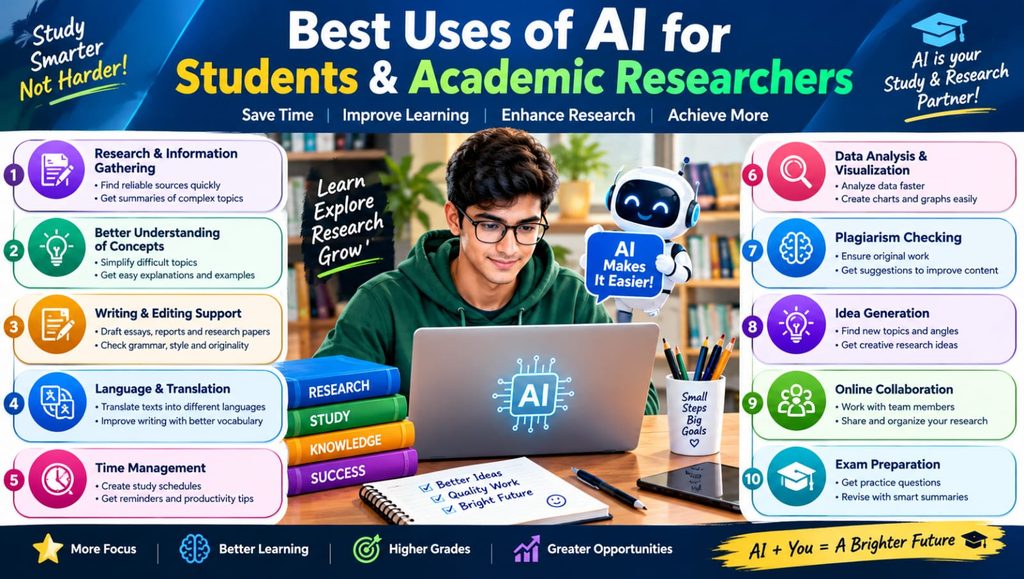
Best Uses for Students and Academic Researchers
Students can use AI Research Assistant Tools to make assignments, projects, and literature reviews more manageable. For example, a student researching climate change can use an AI assistant to identify important research papers, summarize complex studies, and generate possible research questions.
Academic researchers can also use these platforms when exploring a new field. AI can help identify connections between studies, discover related research, and organize large collections of academic literature.
However, students should avoid submitting AI-generated material as their own original academic work when their institution does not allow it. AI should primarily be used for research assistance, brainstorming, organization, and understanding difficult material.
AI Tools for Literature Reviews
Literature reviews can become challenging because researchers often need to analyze many papers before understanding the current state of a subject. AI Research Assistant Tools can make this process more efficient by helping researchers discover relevant studies and identify common themes.
Some AI platforms can analyze papers and help users understand relationships between different studies. Others can provide summaries or help organize sources according to specific topics.
A useful literature review workflow can include:
- Define the research topic.
- Identify important keywords.
- Search for relevant academic papers.
- Organize the discovered sources.
- Summarize important studies.
- Compare findings between researchers.
- Identify research gaps.
- Verify information using original publications.
The final literature review should always reflect the researcher’s own evaluation and understanding rather than simply copying AI-generated summaries.
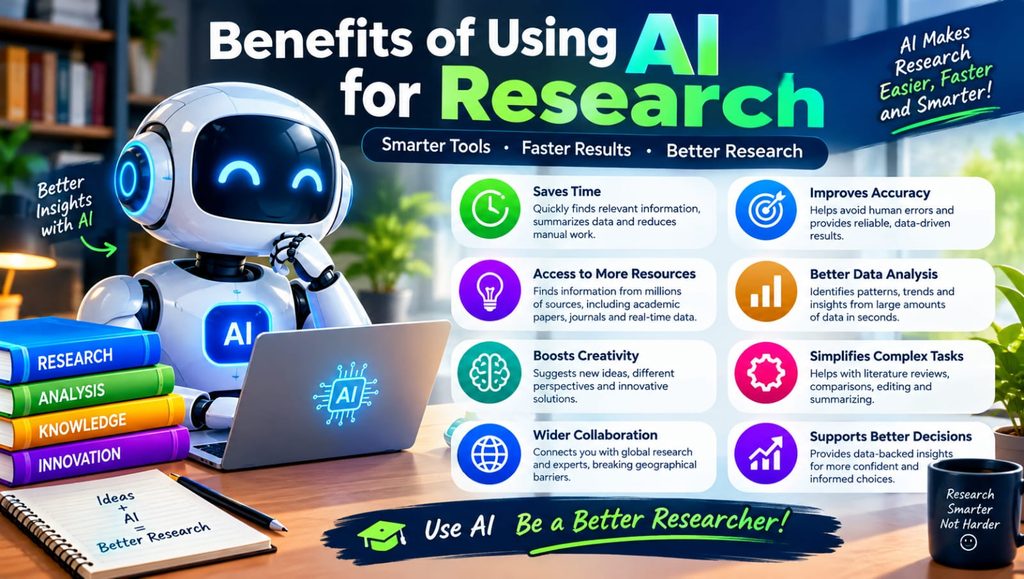
Benefits of Using AI for Research
The growing popularity of AI Research Assistant Tools comes from their ability to improve research efficiency. Researchers can spend less time on repetitive tasks and more time evaluating evidence and developing meaningful conclusions.
Faster information discovery
AI can process search queries and large collections of information quickly, helping users identify potentially useful sources.
Better organization
Research assistants can help organize papers, notes, summaries, and references, making it easier to return to important information later.
Easier understanding of complex topics
Researchers can ask AI to explain complicated concepts in simpler language. This can be particularly useful when working with technical academic literature.
Improved productivity
Automating repetitive tasks can save valuable time, especially during large research projects.
Support for brainstorming
AI can help researchers generate possible questions, research directions, keywords, and ideas that can later be evaluated and developed by humans.
Despite these advantages, AI-generated information can sometimes contain errors, outdated information, or unsupported claims. Verification remains an essential part of responsible research.
Limitations and Challenges of AI Research Tools
Although AI Research Assistant Tools can provide significant benefits, they also have limitations that researchers should understand before using them for important projects.
Accuracy problems
AI systems may occasionally produce incorrect information or misunderstand the context of a source. Important claims should therefore be checked against reliable primary sources.
Citation concerns
Not every AI-generated citation is reliable. Researchers should confirm that cited papers actually exist and that they support the statements being made.
Limited understanding
AI can process and summarize information, but it does not necessarily understand a research problem in the same way as a human expert.
Privacy concerns
Researchers should be careful when uploading confidential documents, unpublished research, personal information, or proprietary data to third-party platforms.
Overdependence
Using AI for every research decision can reduce critical thinking. The researcher should remain responsible for evaluating evidence and drawing conclusions.
For these reasons, AI works best as a productivity assistant rather than a replacement for human expertise.
See more:AI Research Assistant Tools
How to Choose the Right AI Research Assistant
Choosing the right AI Research Assistant Tools depends on your research goals, budget, subject area, and preferred workflow. A student looking for help with academic papers may need different features from a business professional conducting market research.
Before choosing a platform, consider the following:
Research purpose: Determine whether you need academic paper discovery, document analysis, summarization, citation management, or general web research.
Source quality: Check whether the platform provides reliable and traceable sources.
Ease of use: A simple interface can make the research process more efficient, especially for beginners.
Document support: If you regularly work with PDFs or research papers, look for tools that can analyze uploaded documents.
Citation features: Academic researchers should consider platforms that make references easier to organize and verify.
Cost: Many AI tools offer free plans, while advanced features may require a subscription.
Privacy: Review the platform’s data policies before uploading sensitive or unpublished research.
A practical approach is to test a few tools with the same research question and compare the quality of their results, source transparency, usability, and overall usefulness.
Frequently Asked Questions
1. What are AI Research Assistant Tools used for?
AI Research Assistant Tools are used to support research tasks such as finding information, analyzing documents, summarizing papers, discovering sources, organizing notes, and generating research ideas.
2. Can AI research assistants replace human researchers?
No. AI can automate many repetitive tasks, but human researchers are still needed to evaluate evidence, verify sources, understand context, and make informed conclusions.
3. Are AI research tools useful for students?
Yes. They can help students understand difficult topics, find relevant sources, summarize papers, organize information, and develop research questions. Students should follow their school’s or university’s AI-use policies.
4. Are AI-generated research results always accurate?
No. AI systems can sometimes produce inaccurate information, incorrect citations, or misleading summaries. Important facts should always be verified against trustworthy original sources.
5. How should I choose an AI research assistant?
Choose a tool based on your research goals, source quality, document-analysis features, citation support, ease of use, pricing, and privacy policies. Testing several platforms can help you determine which one best fits your workflow.


Pingback: AI Browser Agents