AI SEO Tools have become essential for bloggers, businesses, agencies, and content marketers who want to rank higher on Google in 2026. Instead of spending hours on keyword research, content optimization, technical audits, and competitor analysis, these tools automate many SEO tasks while improving accuracy and productivity.
The best AI SEO Tools combine artificial intelligence, machine learning, and automation to help create SEO-friendly content, identify ranking opportunities, improve website performance, and support long-term organic growth. This guide covers the top AI SEO Tools, their features, benefits, pricing considerations, and future trends.
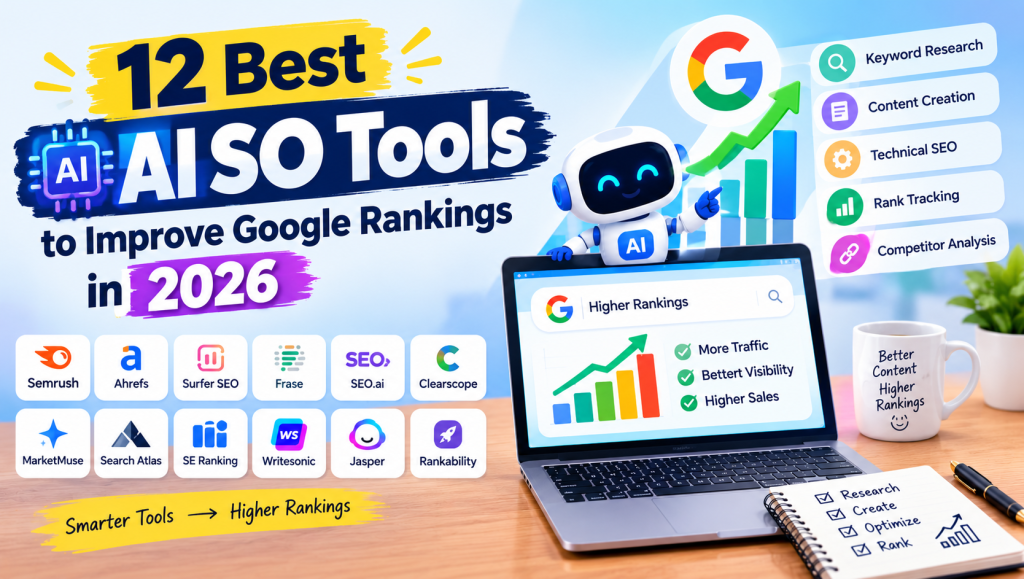
Quick Comparison Table: Best AI SEO Tools in 2026
| AI SEO Tool | Best For | Key Feature |
|---|---|---|
| Semrush | All-in-one SEO | Keyword research & competitor analysis |
| Ahrefs | Backlinks | Link analysis & site audit |
| Surfer SEO | Content optimization | Real-time SEO scoring |
| Frase | AI writing | Content briefs & optimization |
| SEO.ai | AI content | SEO-focused article generation |
| Clearscope | Content quality | NLP keyword suggestions |
| MarketMuse | Content strategy | Topic authority planning |
| Search Atlas | SEO automation | AI SEO agents |
| SE Ranking | Rank tracking | Performance reports |
| Writesonic | AI writing | Blog generation |
| Jasper AI | Copywriting | Brand voice customization |
| Rankability | Content optimization | Competitor content analysis |
AI SEO Tools, Features, and Core Capabilities
Modern AI SEO Tools combine artificial intelligence SEO software, AI-powered SEO platforms, and intelligent SEO software into a single workflow. These solutions automate repetitive tasks while improving search optimization software performance across multiple websites.
The best AI SEO Tools include AI SEO automation, AI SEO assistants, AI SEO agents, SEO workflow automation, AI-powered digital marketing dashboards, and machine learning for SEO. These features help improve SEO productivity, automate SEO tasks, and deliver better search visibility.
AI Keyword Research and Search Intent Analysis
One of the biggest strengths of AI SEO Tools is AI keyword research and search intent optimization. They automatically discover primary keywords, secondary keywords, semantic keywords, LSI keywords, and long-tail keyword opportunities with less manual effort.
Advanced platforms perform keyword clustering, keyword grouping, keyword difficulty analysis, competitor keyword research, keyword gap analysis, topical keyword mapping, and People Also Ask research. This helps create content that matches informational, commercial, transactional, and navigational search intent.
AI Content Creation and SEO Writing Tools
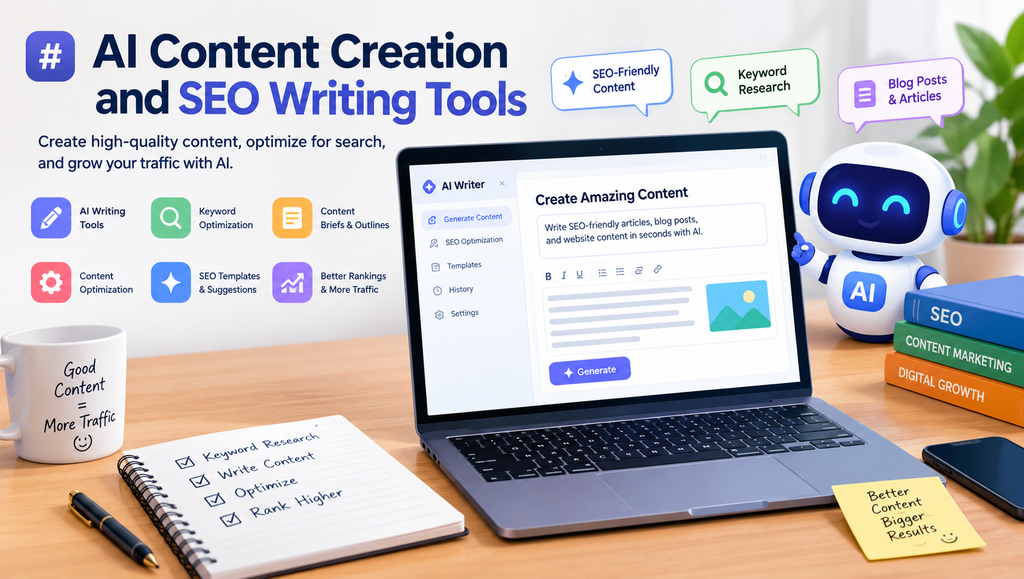
Many AI SEO Tools include AI content writing tools that generate SEO-friendly articles, blog posts, outlines, content briefs, and long-form content. These features speed up content production while maintaining a structured workflow.
Natural language generation, AI copywriting software, content rewriting, content expansion, readability analysis, and brand voice customization help writers create optimized content. Human-edited AI writing remains important for fact-checking AI content and maintaining originality.
On-Page SEO and Content Optimization
On-page optimization becomes easier with AI SEO Tools because they analyze content in real time. They improve keyword placement optimization, heading structure optimization, title tags, meta descriptions, URL slug optimization, and internal linking suggestions.
These tools also evaluate content optimization scores, semantic relevance, content length benchmarking, NLP-based content analysis, featured snippet optimization, and content freshness. Existing articles can often gain higher rankings after proper optimization.
AI Technical SEO and Website Auditing
Technical improvements are another reason professionals rely on AI SEO Tools. They perform automated website audits, website crawling, crawl error detection, broken link analysis, duplicate content detection, and Core Web Vitals monitoring.
These platforms also analyze XML sitemaps, robots.txt files, canonical tags, page indexing issues, mobile-friendly performance, structured data validation, redirect errors, and website architecture. Automated SEO fixes save valuable time during technical maintenance.
AI Competitor Analysis and SERP Research
Competitive research becomes faster with AI SEO Tools because they compare your content against top-ranking pages. They identify competitor keyword gaps, content gaps, backlink opportunities, and organic search competitors.
SERP analysis tools monitor search engine results pages, ranking signals, domain authority comparisons, competitor traffic analysis, and content benchmarking. These insights help build stronger SEO strategies based on real search performance.
AI SEO Automation and End-to-End Workflows
Businesses increasingly choose AI SEO Tools because they automate entire SEO workflows. AI-powered publishing, automated content planning, CMS integration, WordPress SEO automation, and content scheduling reduce manual work.
Autonomous SEO agents manage automated keyword discovery, AI article generation, internal linking, website monitoring, multi-site SEO management, and SEO reporting automation. Human-in-the-loop workflows ensure quality remains under editorial control.
AI Search Visibility, GEO, and Answer Engine Optimization
Search is evolving beyond traditional rankings, making AI SEO Tools valuable for generative engine optimization. GEO tools improve AI search visibility across Google AI Overviews, ChatGPT Search, Perplexity, and Gemini.
These tools monitor AI citation tracking, brand mentions in AI responses, LLM visibility tracking, AI share of voice, answer engine rankings, conversational search optimization, entity optimization, and AI referral traffic to increase overall online presence.
SEO Analytics, Rank Tracking, and Performance Reporting
Every successful SEO campaign depends on accurate data, and AI SEO Tools provide detailed analytics. They track keyword positions, organic traffic, search visibility, ranking fluctuations, impressions, clicks, and conversion performance.
Google Search Console integration, Google Analytics integration, SEO KPI monitoring, traffic forecasting, content performance analytics, and SEO reporting automation help businesses make data-driven decisions with confidence.
AI SEO Tools Integrations and Platform Compatibility
The best AI SEO Tools connect with popular platforms like WordPress, Shopify, WooCommerce, Google Docs, Google Analytics, Google Search Console, and content management systems for smoother workflows.
Many platforms also offer SEO API integration, multilingual SEO support, ecommerce SEO integrations, marketing automation platforms, cloud-based collaboration, and enterprise SEO compatibility for teams managing multiple projects.
Best AI SEO Tools and Popular Software Comparisons
Choosing the right AI SEO Tools depends on your goals and budget. Beginners often prefer SE Ranking or Writesonic, while professionals use Semrush, Ahrefs, Surfer SEO, Frase, Clearscope, MarketMuse, Search Atlas, Rankability, SEO.ai, and Jasper AI.
Each platform offers different strengths, including AI keyword research software, AI website audits, content optimization, AI writing assistants, rank tracking, backlink analysis, and SEO automation. Testing free trials can help identify the best fit.
Benefits of Using AI SEO Tools
The biggest advantage of AI SEO Tools is improved Google rankings through smarter automation. They reduce manual research, strengthen internal linking, improve content quality, increase topical authority, and help identify valuable ranking opportunities.
Businesses also benefit from streamlined editorial workflows, scalable content production, faster keyword targeting, improved website performance, simplified SEO reporting, enhanced content relevance, and better marketing productivity over time.
AI SEO Tools Pricing, Free Plans, and Limitations
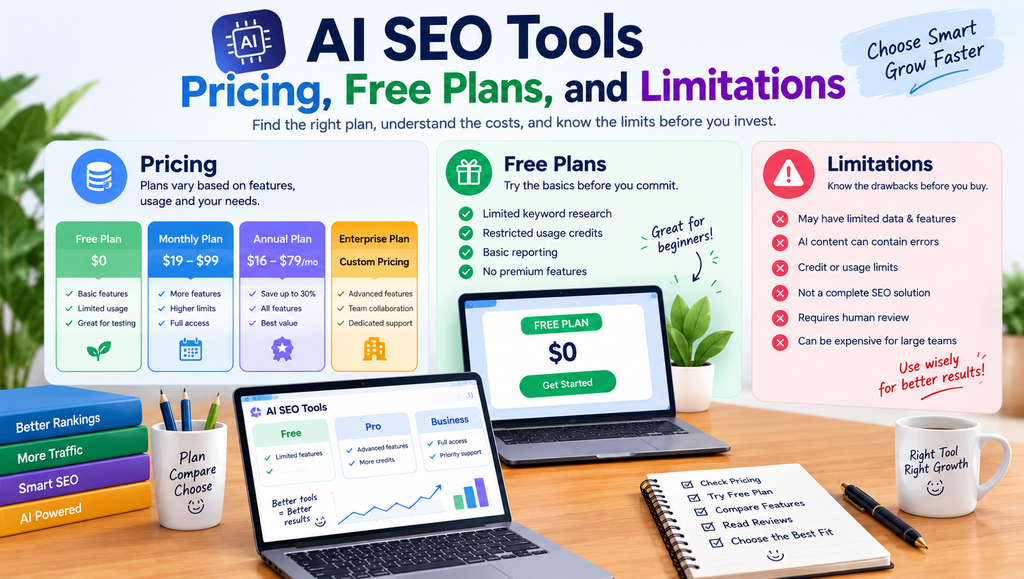
Most AI SEO Tools offer free plans, monthly subscriptions, annual discounts, and trial periods. Pricing usually depends on keyword limits, content generation credits, website audits, rank tracking capacity, and team collaboration features.
Despite their advantages, AI-generated content may contain factual errors, AI hallucinations, duplicate content risks, and over-optimization issues. Following Google spam policies and using human editorial review remains essential for long-term success.
AI SEO Strategy, Best Practices, and Future Trends
The future of AI SEO Tools focuses on people-first content, E-E-A-T principles, semantic SEO, entity-based optimization, topic clusters, pillar pages, and search intent matching rather than keyword stuffing.
Successful SEO strategies will combine structured data, mobile optimization, internal linking, content refresh schedules, natural keyword integration, and AI-assisted workflows. Businesses that adapt to AI-powered search will have stronger visibility in 2026 and beyond.
See more:AI SEO Tools
How to Choose the Right AI SEO Tools for Your Website
Choosing the right AI SEO Tools depends on your website goals, budget, content strategy, and SEO experience. Bloggers should focus on keyword research, content optimization, and article writing, while businesses may need technical SEO audits, competitor analysis, and rank tracking to improve organic performance.
Before purchasing any platform, compare its features, pricing, free trial, integrations, and reporting capabilities. The best AI SEO Tools should save time, identify useful ranking opportunities, and support high-quality, people-first content. Start with the features you need most and upgrade as your website grows.
Conclusion
AI SEO Tools have transformed how websites grow organic traffic in 2026. From AI keyword research and content optimization to technical audits and competitor analysis, these platforms help businesses work faster while making smarter SEO decisions.
However, the most successful strategy combines AI SEO Tools with human creativity, fact-checking, and a people-first content approach. When used correctly, these tools can improve Google rankings, increase organic traffic, and build long-term topical authority.
1. What are AI SEO Tools?
AI SEO Tools are software platforms that use artificial intelligence to automate keyword research, content optimization, technical SEO, competitor analysis, and rank tracking.
2. Which AI SEO Tool is best for beginners?
SE Ranking, Writesonic, and Frase are excellent beginner-friendly options because they combine simple interfaces with powerful SEO features.
3. Can AI SEO Tools improve Google rankings?
Yes, AI SEO Tools can improve rankings by optimizing content, identifying keyword opportunities, fixing technical SEO issues, and improving search intent alignment.
4. Are free AI SEO Tools worth using?
Free AI SEO Tools are useful for basic keyword research, content creation, and website analysis, although premium plans usually provide more advanced features.
5. Will AI replace human SEO experts?
No. AI accelerates research and automation, but human expertise is still necessary for strategy, fact-checking, creativity, and maintaining high-quality, trustworthy content.