

AI research tools are changing how students, researchers, writers, marketers, and professionals find and understand information online. Instead of spending hours opening different websites, reading lengthy documents, and organizing notes manually, modern research platforms can help users discover relevant information and turn it into useful research insights.
AI research tools can support almost every stage of online research, including information discovery, academic paper search, literature review, document summarization, source verification, data analysis, and research reporting. The right platform can make a research workflow more organized while still allowing users to review original sources and make their own conclusions.
AI Research & Discovery
AI research tools are designed to make the research process faster and more organized. An AI research assistant can help users explore a topic, understand research questions, discover useful information, and identify sources that may deserve further investigation.
AI-powered research tools can also support an AI research workflow by combining search, analysis, summarization, and organization features. These artificial intelligence research tools can be useful for students, academics, business professionals, journalists, content creators, and anyone who regularly works with large amounts of information.
Academic Research & Literature Review
AI research tools can be especially helpful for academic research because students and researchers often need to examine many papers before understanding a topic. Academic research tools can help users discover scholarly sources, peer-reviewed research, scientific papers, and academic studies.
AI literature review platforms can simplify literature discovery by helping researchers locate relevant publications and compare related studies. Literature review tools can also support an academic research assistant by organizing information from multiple papers and highlighting potentially useful research.
Academic paper search is another important feature for researchers. Scholarly research tools can help users discover research publications, scientific literature, and academic papers related to specific research questions.
Research Data Analysis
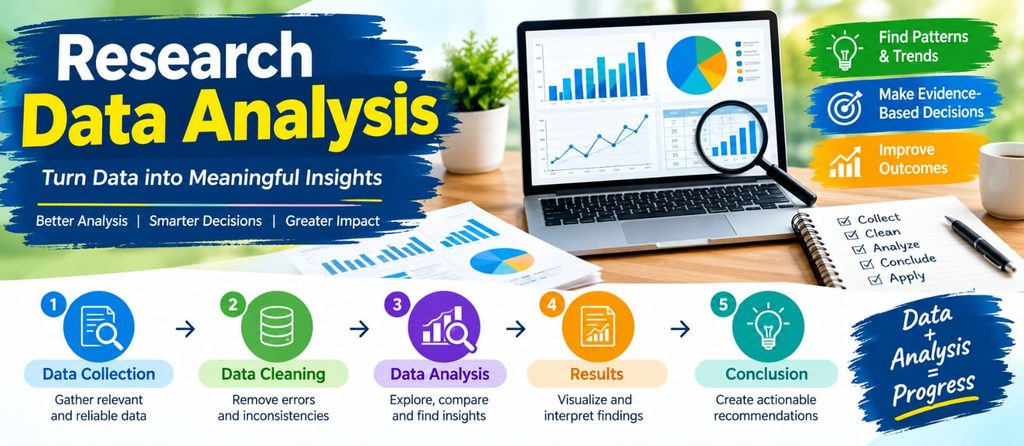
AI research tools can also help researchers analyze information contained in datasets. AI data analysis can identify patterns, organize large amounts of information, and support researchers when they need to interpret complex data.
Research data analysis becomes easier when data analysis tools provide structured ways to examine datasets. AI-powered data analysis can allow users to explore information through natural language data analysis instead of depending entirely on complicated technical commands.
Research analytics can include data visualization, research charts, statistical analysis, and trend analysis. These features can help researchers identify patterns and communicate research findings in a clearer format.
Research Sources & Citations
AI research tools can help users discover research sources, but finding a source is only the first step. Researchers should also evaluate source credibility, verify important information, and check whether a source genuinely supports the claim being made.
Source discovery features can make research faster by identifying potentially relevant publications and websites. Source verification, citation analysis, citation tracking, and citation verification can then help users understand how information is connected to existing research.
Reliable sources are particularly important for academic and professional work. Source validation can help researchers evaluate scholarly references, supporting evidence, and other materials before using them in a report or article.
AI Search & Information Discovery
AI research tools can improve information discovery by allowing users to search using natural language. Instead of entering several short keywords, users can describe a complete research question and receive information related to the meaning of the query.
AI search tools can use semantic search to understand the context behind a question. This can be useful when different publications use different terminology for the same concept or when researchers are exploring a broad subject.
An academic search engine can help users find scholarly publications, while a research search engine can focus on research-oriented information. Intelligent search can also help identify relevant sources that may not appear through simple keyword matching.
Research Paper Summarization & Extraction
AI research tools can save time when researchers need to review long academic papers. An AI paper summarizer can provide an overview of a document and highlight important information such as research objectives, methods, findings, and conclusions.
Academic paper summarizers are particularly useful during the early stages of literature review. Instead of reading every paper from beginning to end before deciding its relevance, researchers can use document summarization to understand the main subject and then examine important papers more deeply.
Research document analysis can also support paper extraction. Users can extract key findings, research evidence, methods, outcomes, and other information from academic documents.
Research Reports & Synthesis
AI research tools can help turn information from multiple sources into organized research reports. AI research reports can bring together relevant information and present it in a format that is easier to review.
Automated research reports can be useful for preliminary research, briefings, summaries, and topic exploration. AI-powered research synthesis can help users connect findings from different sources and identify common themes or differences.
Evidence synthesis is another useful part of the research process. Comprehensive research and deep research features can explore information across multiple sources, while cross-source analysis can help users compare evidence from different publications.
Research Productivity & Workflow
AI research tools can improve research productivity by reducing repetitive tasks such as searching, summarizing, organizing, and documenting information. This gives researchers more time to focus on evaluating evidence and developing their own analysis.
Research workflow automation can connect different parts of the research process. Automated literature search, research organization, research planning, and research monitoring can help users maintain a consistent approach throughout a research project.
Research management platforms can also support research collaboration and documentation. Researchers working in teams can organize notes, sources, findings, and project information in one workflow instead of keeping information across disconnected documents.
Research Tools & Platforms
AI research tools come in many forms, and different platforms focus on different research requirements. Elicit is designed to support research and literature workflows, while Consensus focuses on finding research-backed information from scientific literature.
Julius AI is focused on data analysis, while Perplexity AI provides AI-powered search and information discovery. ResearchRabbit helps users explore connections between academic papers and research topics.
| Research Tool | Primary Use | Suitable For |
|---|---|---|
| Elicit | Literature discovery | Academic research |
| Julius AI | Data analysis | Research datasets |
| Perplexity AI | AI-powered search | Online research |
| Consensus | Research-backed search | Scientific research |
| ResearchRabbit | Literature discovery | Researchers and students |
| Scite | Citation analysis | Source evaluation |
| Semantic Scholar | Academic search | Research papers |
| SciSpace | Research document analysis | Literature review |
| Scholarcy | Paper summarization | Academic research |
| ChatPDF | Document analysis | PDF research |
| Keenious | Research discovery | Scholarly research |
| Connected Papers | Paper relationship mapping | Literature exploration |
Academic AI tools can therefore support different stages of research rather than performing exactly the same function. Scholarly AI tools are generally focused on academic information, while broader research assistants can help with online information discovery and general research tasks.
How to Choose the Right AI Research Tool
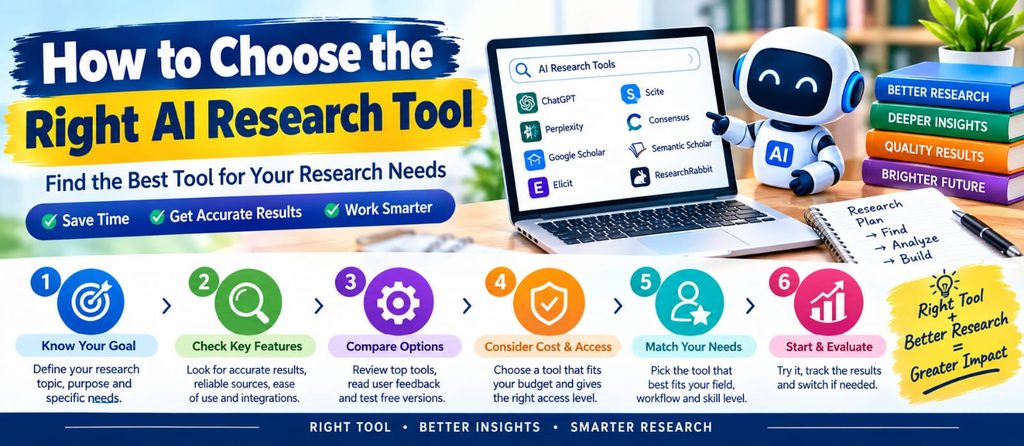
AI research tools should be selected according to the type of research you perform. A student may need academic paper search and summarization, while a data analyst may require dataset analysis, data visualization, and statistical features.
Researchers should compare source coverage, citation functionality, document support, search quality, ease of use, available integrations, and pricing. A platform designed for literature discovery may not provide the same capabilities as a platform focused on research data analysis.
Source transparency should also be considered. Researchers need to know where information comes from so they can verify important claims. This is particularly important when a platform produces summaries or answers based on multiple sources.
Key Benefits of AI Research Tools
AI research tools can reduce the amount of time required to find relevant information. Researchers can use search, summarization, extraction, and organization features to process information more efficiently.
Another benefit is improved research organization. Instead of keeping separate notes for every source, researchers can use research platforms to collect papers, findings, citations, and important information in a structured workflow.
These tools can also make difficult information easier to understand. A long research paper can be summarized, a large dataset can be explored, and several sources can be compared more efficiently.
However, users should treat AI-generated information as research assistance rather than automatically accepted evidence. Original sources, citations, methods, and research findings should be checked before important information is used.
See more:AI research tools
Frequently Asked Questions
1. What are AI research tools?
AI research tools are software platforms that use artificial intelligence to help users search for information, discover sources, analyze documents, summarize research papers, organize evidence, and support research workflows.
2. Which AI tools are useful for academic research?
Elicit, Consensus, ResearchRabbit, Scite, Semantic Scholar, SciSpace, and Scholarcy are examples of platforms that support different academic research tasks, including literature discovery, paper analysis, citations, and summarization.
3. Can AI research tools replace traditional research?
No. AI research tools can make research faster, but they should not replace source evaluation or independent analysis. Researchers should review original sources and verify important claims before using them.
4. Are AI research tools useful for students?
Yes. AI research tools can help students discover academic papers, understand difficult documents, organize research information, and explore unfamiliar subjects. Students should also follow their school’s or university’s rules for AI-assisted work.
5. How can I use AI research tools effectively?
AI research tools work best when you start with a clear research question, use reliable sources, compare multiple references, verify important claims, and read original papers when detailed evidence is required.

