
AI Search Engines are transforming how people discover information online in 2026. Instead of opening dozens of websites, users can ask questions in everyday language and receive clear answers, helpful summaries, and links to relevant sources. These tools make online research easier for students, professionals, business owners, and anyone who wants reliable information quickly.
AI Search Engines also help users compare different viewpoints, understand complicated subjects, and discover useful resources with less effort. From academic research to business analysis, the right platform can save time and improve productivity. This guide explores 10 popular tools, their features, benefits, limitations, and practical uses to help you choose the best option.
AI Search Engines: Definition and Core Concepts
AI Search Engines are online platforms that use artificial intelligence to understand questions and retrieve relevant information. They combine natural language processing, machine learning, and advanced language models to interpret user intent. Unlike basic keyword searches, these intelligent search engines can recognize context and provide more meaningful answers.
Modern AI-powered search tools support conversational queries, automated information discovery, and context-aware results. Some generate direct answers with citations, while others combine traditional links with summaries and recommendations. This approach makes information easier to understand and helps users explore topics without manually visiting numerous webpages.
Best AI Search Engines and Popular Platforms
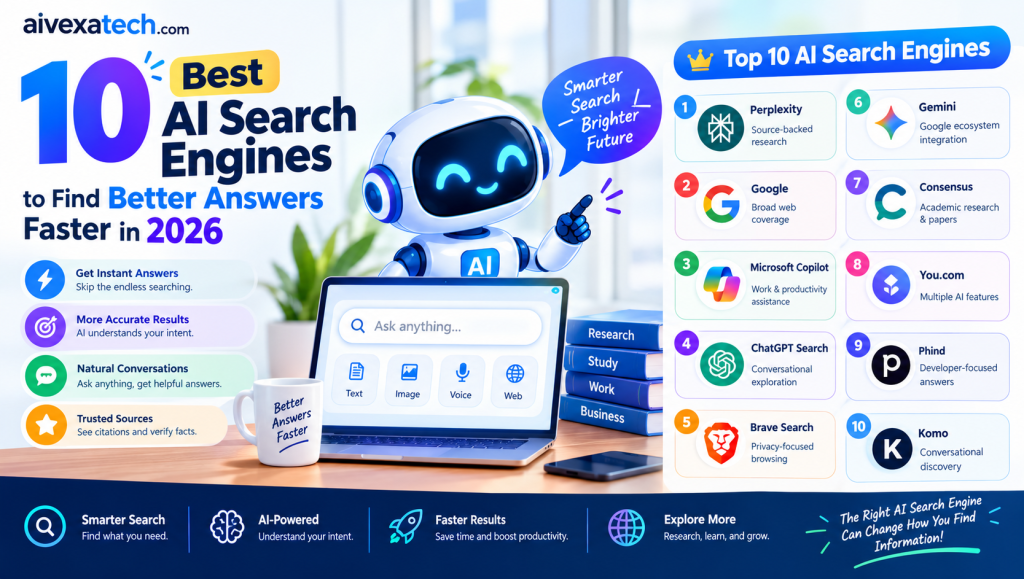
The best AI Search Engines offer different features depending on the user’s needs. Popular choices include Perplexity, Google Search, Microsoft Copilot, ChatGPT Search, Brave Search, Gemini, Consensus, You.com, Phind, and Komo. Some focus on general web searches, while others specialize in academic research, technical questions, or conversational assistance.
Choosing the right platform depends on your research goals, budget, and preferred workflow. Perplexity is useful for source-backed answers, Google provides broad web discovery, and ChatGPT supports conversational exploration. Consensus is particularly useful for finding scientific studies, while Phind can help developers investigate programming questions.
Top 10 AI Search Engines Compared
| Platform | Best use | Main advantage |
|---|---|---|
| Perplexity | Online research | Answers with source links |
| Google Search | Everyday searches | Broad web coverage |
| Microsoft Copilot | Work and productivity | Search with AI assistance |
| ChatGPT Search | General questions | Conversational answers |
| Brave Search | Privacy-conscious browsing | Independent search experience |
| Google Gemini | Research and Google integration | Connected Google ecosystem |
| Consensus | Academic research | Scientific paper discovery |
| You.com | AI-assisted research | Multiple search and AI features |
| Phind | Programming and technical research | Developer-focused explanations |
| Komo | Exploratory searches | Conversational discovery |
Note: Features, pricing, free-plan limits, and regional availability may change. Check each platform’s official website for current details.
How AI Search Engines Work
AI Search Engines process user questions through technologies such as natural language processing (NLP), machine learning, semantic search, and large language models (LLMs). These technologies help identify the meaning of a question instead of matching only individual words. Search intent recognition also helps systems understand what information a user actually needs.
Many platforms retrieve relevant information from search indexes or live web sources before generating an answer. Some use retrieval-augmented generation (RAG) to connect retrieved documents with a language model. Vector embeddings, knowledge graphs, intelligent ranking algorithms, and current web data can further improve how information is discovered and organized.
See more:AI Search Engines
AI Search Engine Features and Capabilities
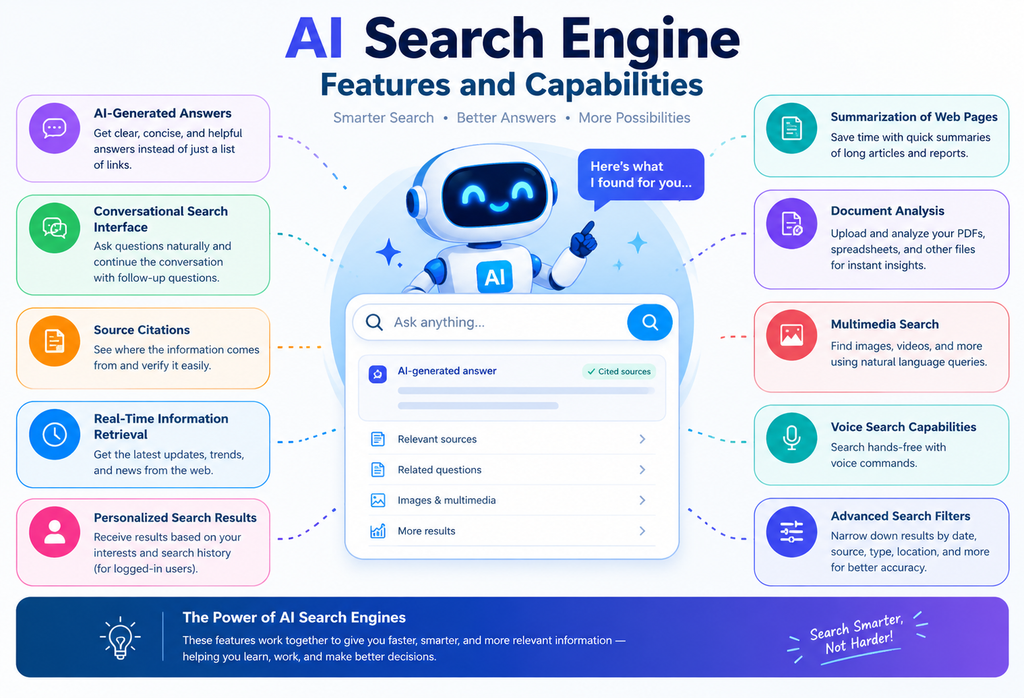
Modern AI Search Engines offer conversational interfaces, AI-generated answers, source citations, follow-up questions, and webpage summaries. These features allow users to investigate a topic through natural language queries instead of repeatedly searching for separate keywords. Depending on the platform, users may also access document analysis, image search, voice search, and advanced filters.
Additional capabilities include multi-step research, contextual recommendations, and information synthesis from several sources. Some tools can analyze uploaded documents or connect with productivity applications. These features make intelligent search particularly useful for lengthy reports, complicated questions, and tasks that require information from multiple webpages.
AI Search Engines vs Traditional Search Engines
Traditional search engines generally display ranked webpages based on relevance, keywords, authority, and other ranking signals. Users open individual links to compare information and build their own understanding. This method remains valuable when finding original articles, official documents, product pages, and a wide range of independent sources.
AI Search Engines provide a different experience by summarizing information and answering questions conversationally. However, generated responses may leave out important context or misinterpret evidence. Traditional results offer greater control over source selection, while AI-generated answers can reduce research time. Combining both methods often provides a more complete search experience.
Benefits and Advantages of AI Search Engines
One of the biggest benefits of AI Search Engines is faster information discovery. Users can begin with a concise explanation instead of reading several lengthy webpages. This saves time, reduces information overload, and makes complex subjects easier to understand. Students and professionals can use these tools to organize research and explore unfamiliar topics.
These platforms can also improve productivity through automated summaries, comparisons, and research assistance. Businesses may use them to investigate market trends, while students can explore educational topics and prepare study notes. Although these features support better decision-making, important facts should always be checked against reliable sources.
AI Search Engines for Research, Education, and Business
AI Search Engines can help students discover learning resources, understand difficult concepts, and locate academic publications. Tools such as Consensus focus on scientific literature, while general-purpose platforms help explain terminology and identify relevant research topics. Researchers should consult original papers, examine study methods, and verify findings before including them in academic work.
Businesses can use these platforms for competitor analysis, customer research, market insights, and workplace knowledge discovery. Enterprise search solutions may help employees find information across approved company documents. These applications can support informed decisions and improve efficiency, but organizations should protect confidential information and follow their internal data security policies.
AI Search Engine Accuracy, Citations, and Reliability
Accuracy is essential when evaluating AI Search Engines. A confident answer is not necessarily a correct one. AI systems can misunderstand questions, rely on outdated information, overlook contradictory evidence, or produce unsupported claims. These errors are often called AI hallucinations and can affect the reliability of generated responses.
Source citations make verification easier, but users should confirm that the linked pages genuinely support the claims being made. Compare multiple reputable sources, check publication dates, and prioritize authoritative websites. For medical, legal, financial, or other high-impact decisions, use trusted professional guidance rather than relying entirely on generated answers.
AI Search Engines: Privacy, Security, and Limitations
Privacy is another important consideration when choosing AI Search Engines. Depending on the service and its settings, search queries, account information, and interaction history may be collected or retained. Review privacy policies, data controls, and search history settings before using a platform, particularly for professional or sensitive research.
Other limitations include inaccurate summaries, biased results, subscription costs, usage restrictions, and inconsistent source quality. Some advanced features require paid plans or account registration. Users should avoid sharing passwords, private financial details, or confidential documents with services that are not approved for handling such information.
AI Search Engines for SEO and Digital Marketing
AI Search Engines are creating new opportunities for SEO professionals and digital marketers. Content creators need to understand search intent, answer user questions clearly, and establish topical authority. Semantic keywords, descriptive headings, useful internal links, and structured data can help search systems interpret webpage content more effectively.
Generative engine optimization (GEO) and answer engine optimization (AEO) focus on improving content visibility in AI-generated answers and answer-focused experiences. Businesses can strengthen their content by publishing original research, citing trustworthy sources, and maintaining accurate information. However, AI citations and brand mentions are not guaranteed, and traditional SEO practices remain important for organic visibility.
AI Search Engines: Future Trends and Innovations
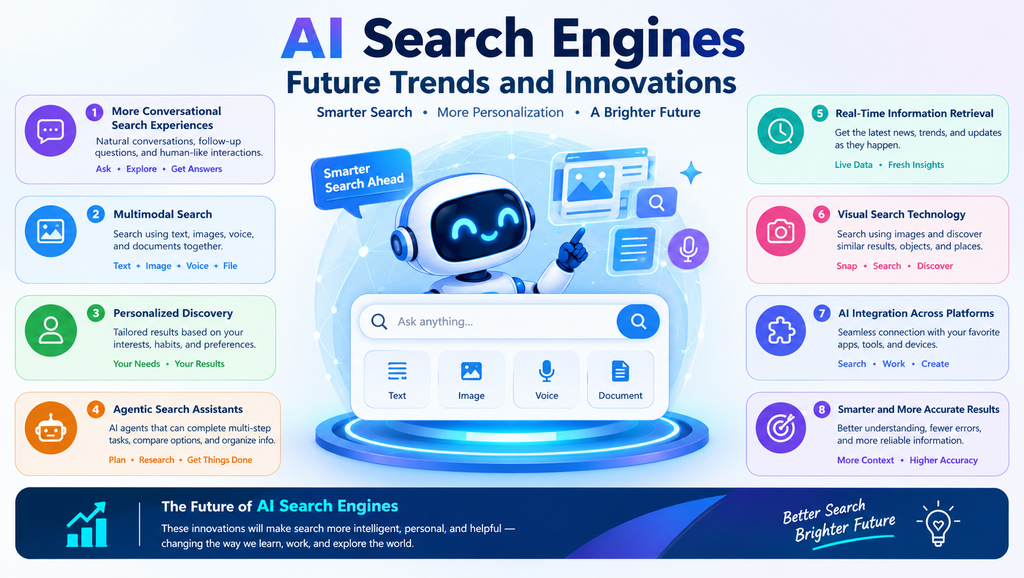
The future of AI Search Engines will likely include more conversational experiences, multimodal search, and personalized information discovery. Users can increasingly expect to combine text, images, voice, and documents when exploring questions. Improvements in language models and real-time retrieval may make complex research more accessible to everyday users.
Agentic search assistants may also help people complete multi-step research tasks, organize findings, and compare information from different sources. At the same time, privacy, transparency, and factual accuracy will remain essential. The most useful platforms will balance advanced capabilities with reliable evidence and meaningful user control.
AI Search Engine Comparison and Buying Factors
When comparing AI Search Engines, evaluate answer quality, citation reliability, search speed, ease of use, privacy controls, and supported languages. Students may prefer academic research features, while business professionals may need document analysis and productivity integrations. Everyday users may find a general-purpose platform sufficient for routine questions and online discovery.
Pricing is another important consideration because free plans may have usage limits or restricted features. Check subscription costs, mobile compatibility, available integrations, and access to current web information before choosing a service. The best platform is the one that meets your requirements, provides useful evidence, and fits your budget.
See more:AI Search Engines
Final Thoughts
AI Search Engines are changing how people discover, evaluate, and understand online information. Platforms such as Perplexity, Google Search, Microsoft Copilot, ChatGPT Search, and Consensus offer different advantages for everyday browsing, professional tasks, and academic research.
For the best results, select a tool that matches your needs, verify important claims using original sources, and protect your personal information. Combining AI-assisted research with critical thinking can help you find better answers faster in 2026.
1. What are AI Search Engines?
AI Search Engines are digital tools that use artificial intelligence to understand questions, retrieve relevant information, and provide answers or summaries. Many also offer citations, conversational search, and follow-up questions.
2. Which AI search engine is best in 2026?
The best choice depends on your requirements. Perplexity is useful for source-backed research, Google Search works well for broad web discovery, ChatGPT Search supports conversational exploration, and Consensus specializes in scientific research.
3. Are AI Search Engines free to use?
Many platforms offer free access with certain restrictions. Advanced models, higher usage limits, and additional research features may require a paid subscription. Always check the official pricing page for current plans.
4. Are AI Search Engines more accurate than Google?
Not always. AI tools can explain and summarize information, but they may generate incorrect claims or overlook relevant sources. Traditional search engines are useful for finding original webpages, so comparing both approaches can improve research quality.
5. How can AI Search Engines help with SEO?
They can help marketers understand search intent, research competitors, discover related questions, and identify content gaps. Publishing original, helpful content with clear headings and trustworthy references can support visibility across search platforms.

Pingback: 12 Best AI SEO Tools to Improve Google Rankings in 2026